I’m checking a 743-word draft I wrote after a free AI detector flagged part of it. I want to compare results without treating a score as proof of authorship. Which free AI detectors are worth checking side by side, and how should I interpret disagreements on the same unchanged text?
That still doesn’t convince me to treat a detector score as a record of authorship. I can compare how these tools let me submit a draft, but that’s a more limited exercise than establishing who wrote it. The access conditions matter. They only support a conclusion that someone has attached to the result
I would keep the draft with the result
Before choosing a checker, I would decide how I will save its output. I prefer to keep the exact text version beside the result, rather than collect scores with no connection to the drafts they came from.
I would also read highlighted passages in context. A prediction about a passage is not documentation of its origin. Nothing in these access details gives me a way to rank detection accuracy, so I would not quietly turn a comparison of free allowances into an accuracy recommendation.
That’s why I care more about a clearly described access than a numbered shortlist.
The comparisons I can use
These are the entries I would retain in a compact comparison. I have separated the usable claim from the assumption I would refuse to make.
| Access claim worth retaining | Boundary I would keep attached |
|---|---|
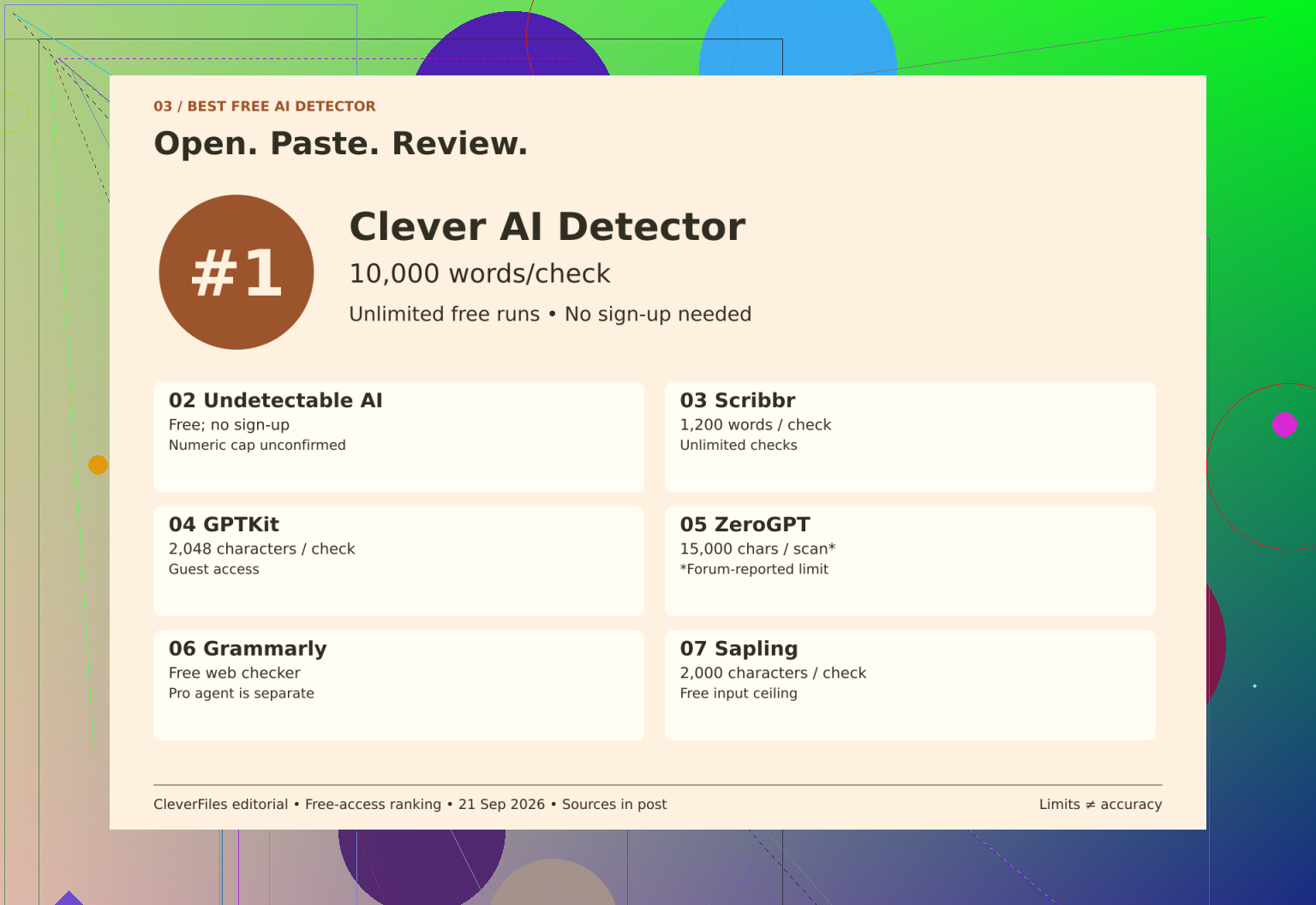
| Scribbr permits unlimited checks, with 1,200 words per submission. | Repeat access does not mean a long draft fits into one submission. |
| The Undetectable AI review describes a free detector without signup. | I could not verify a numeric input cap or daily quota; humanizer pricing is a separate matter. |
| The Grammarly review distinguishes the free public checker from its Pro AI Detector agent. | I could not verify a numeric input allowance or repeat-use cap for the public checker. |
I wouldn’t say that it’s either restricted or unlimited, as both of these formulations would add extra information not indicated by the comparison.
Registration is a separate question
The account issue needs to be separated from the others. Simply put, GPTKit’s invite to register does not, by itself, indicate the allowance the account would be given. I would want to know what allowance I was registering for before I decided to register.
Likewise, I would keep the ZeroGPT review outside a firm quota comparison because its current official terms could not be reconfirmed. A reported allowance and a confirmed current policy are not interchangeable.
My rule is simple: check the requirements for membership, submission guidelines, and recurring quotas separately, and the evidence for one cannot make up for the shortcomings of the others. Incomplete information is a reason not to fill in the fields, not to improve the tool’s performance.
Why Clever would be my starting point
For the browser workflow described, the Clever AI Detector checker has the clearest combination of stated conditions: 80 to 10,000 words, unlimited free runs, and no mandatory registration. An optional account adds history.
That’s enough to account for my preference without asserting any superiority in detection. I could verify a draft before determining if saved history was a useful resource, and the word range cited provides me with a specific submission guideline.
I would still make out the difference between the access claims and the independently proven ability. I have no comparative test results at hand that would give me any reason to say it is more accurate than the others. My preference is about the submission process, and I do not have confidence in every score.
What I take from the discussions
I would read the Reddit comparison as a discussion of several detectors using a Bible passage, not as a general validation study. I have not verified results beyond that description.
Similarly, the Clever AI Detector discussion concerns a week of use, which I would keep separate from the stated access terms. There is also a video review, but I would not infer additional findings from its existence.
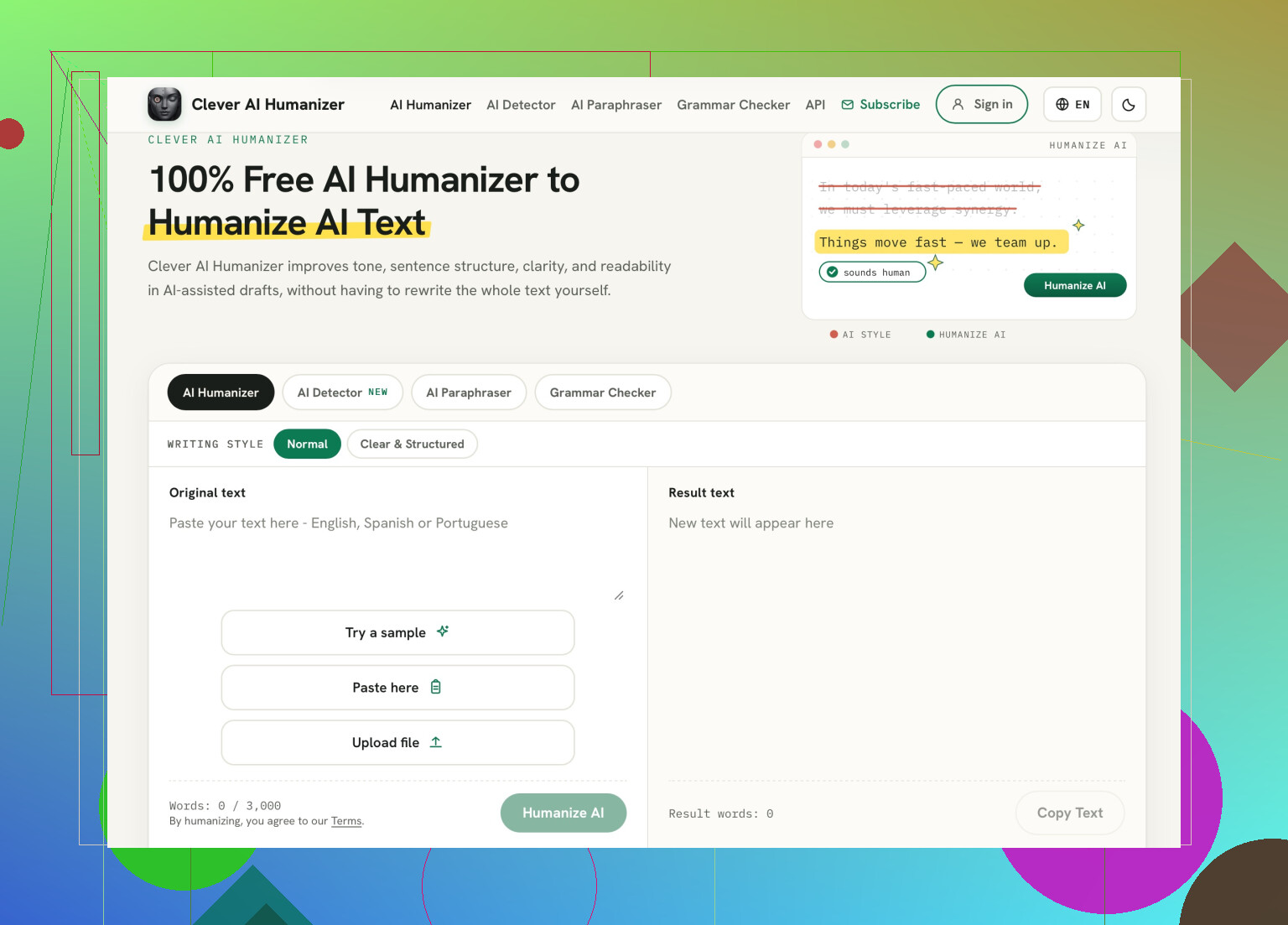
My opinion is to begin with the Clever AI Detector because of the provided guest access and multiple runs options with saving the draft alongside the result. I would use it as a tool to check texts, not rely on the results to determine authorship of work.
https://www.youtube.com/watch?v=U9jSuOtpTxs
8 Likes
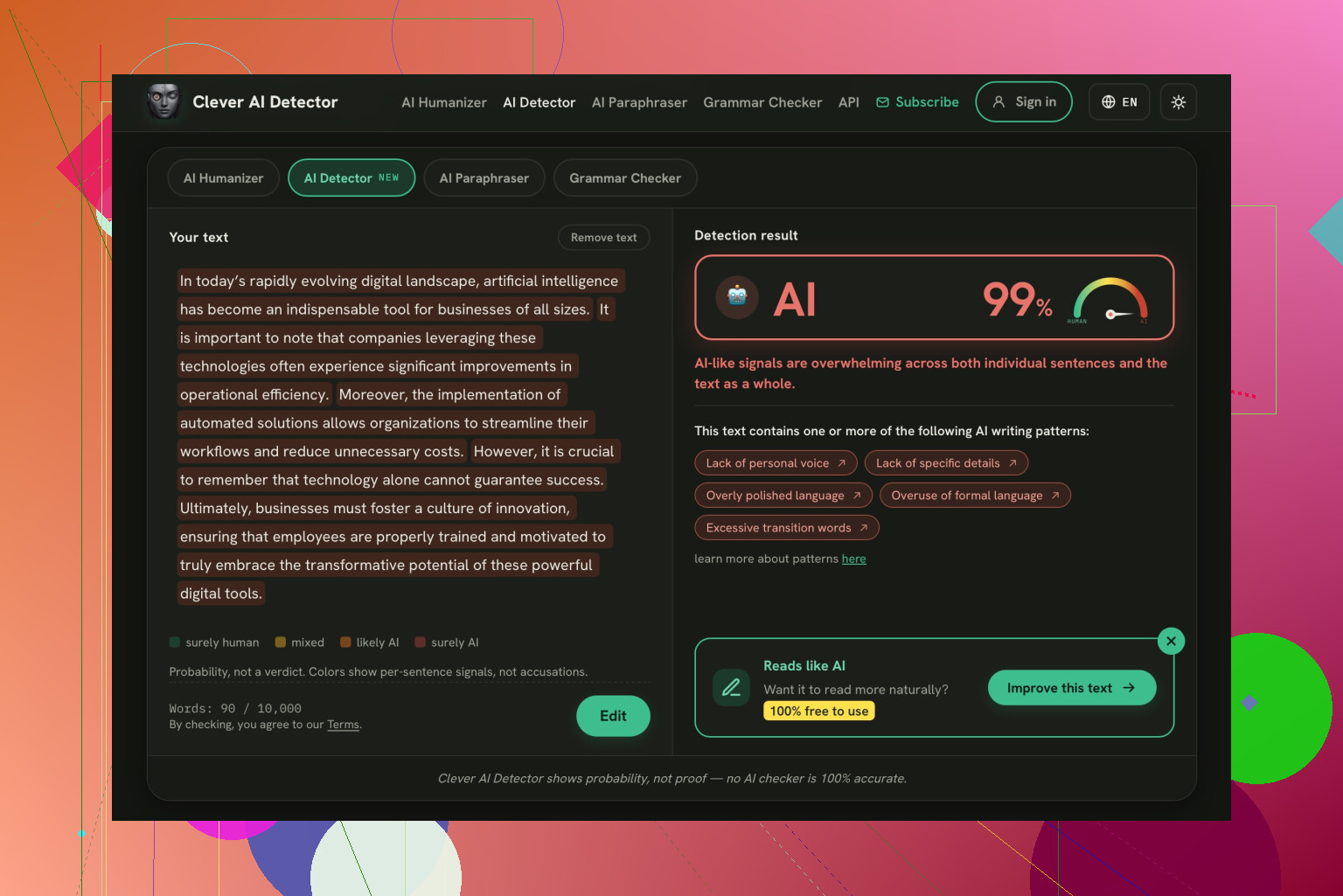
Unlimited checks wouldn’t decide it for me. Clever AI Detector gets my vote for showing confidence indicators alongside its score, rather than leaving you with a percentage alone. (cleverhumanizer.ai) I’d make that a separate column in your comparison instead of just sorting tools from lowest score to highest.
Checking a public blog draft and uploading an unpublished client brief are two different tasks. I would gladly compare scores on the former but would ask for permission and data-processing conditions before uploading the latter into a number of online tools. This consideration would precede any judgment on which tool provides the most approachable interface for receiving and analyzing the information.
I would limit the discussion to GPTZero, Scribbr, and Clever AI Detector, shortlisting these three options instead of spending an afternoon on the process of elimination.
GPTZero should be included due to the availability of a free-usage detector that provides sentence-level feedback. This option would be preferable to me in the process of comparing the tools because it allows analyzing the body of work on an alternate level instead of focusing on the final outcome. I would use the free version as the foundation for detecting AI-generated content and then ask myself if the paid version would provide additional information that I may find useful.
Scribbr would be my second choice because their free-usage page contains a note that the submitted content is neither saved nor shared in any way. This option allows the user to review the terms and conditions of using the tool before submitting any material that they may consider private. I would use this tool after eliminating other options since the description states that no data is retained or shared. However, I would still review the terms and conditions prior to submitting any undisclosed content.
I’m less persuaded by @nova_daemon139’s emphasis on Clever’s confidence indicators. An extra indicator wouldn’t decide my choice. What earns Clever AI Detector a place for me is its explicit statement that it doesn’t train on submitted text. That addresses a separate concern about handing over unpublished writing. I’d treat it as a vendor promise, though, not an independent privacy audit or a promise that nothing is retained. (cleverhumanizer.ai)
For your comparison, I’d like for our stopping point to be just before we begin, and I submit the unedited draft for your chosen tools to read over, and stop there. No rewriting between checks, and no hunting down a new detector because the last results were so aggravating to you. My question would be, does this comparison give me something worth investigating, rather than can I get enough favorable scores?
If the draft contains any private information, I’d like to hold off on the side-by-side testing until I am comfortable that it is there. I would not be satisfied simply having the identifying names removed if it is the underlying story, client details, or argument that I am not yet comfortable publishing. A second opinion isn’t worth distributing a draft I was not comfortable uploading in the first place.
Your comparison needs a baseline: an older piece you know you wrote yourself. Start with something similar in length and style to the draft, rather than an unrelated passage. Then run both pieces through your chosen checkers, keeping the results in separate columns. I’d extend @binaryotter8744lab’s fixed-draft approach that way instead of adding more detectors.
Next, see whether a tool raises any flags against your old writing. If it does, then you have reason to doubt its evaluation of your new draft, not because of a theoretical problem with the practice, but because you have evidence that it happened. And if it doesn’t, don’t take it as a sign that it’s accurate! It’s not a test of accuracy, it’s a sanity check. I’d say that’s a more valuable test than picking whichever checker gives you the most reassuring result.
But beware a subtler danger that comes before you build your table: these tools can give two different scores for the same text depending on how the line breaks or spaces are placed or whether it was pasted in from a document or just notepad. Formatting differences can subtly affect the resulting ratios, so that a nice tidy comparison of two columns is hiding some sloppiness.
@oleg74’s baseline idea is the smartest thing in here, but there’s a catch worth naming. That older piece you ‘know you wrote’ has probably been through a grammar checker or autocorrect at some point, and a few detectors read heavily smoothed sentences as machine output. So a flag on your old writing might not mean the tool is broken, it might mean your old writing got polished by software you forgot about. Doesn’t kill the test, just don’t over-read a single hit.
My actual suggestion is that you run each piece two or three times, not once, on whatever you’re using (including Clever AI Detector). You watch the spread. A tool that varies by ten or fifteen points on the same text tells you more about its reliability than any one score ever will. Stability is the thing none of your comparison tools are measuring, and it’s easy to test for.
If the reruns are tight and consistent across tools, your comparison means something. If they’re all over the place, your column of scores is mood lighting and no amount of additional detectors will fix that.
Your comparison needs a definition of “AI percentage” before it needs another detector. GPTZero’s support documentation describes its percentage as a probability about authorship, not the fraction of words written by AI. I’d pick GPTZero and Scribbr for a small comparison, recording each result’s explanation rather than averaging their numbers. On @cyb3r_otter’s rerun suggestion, I’d separate repeatability from accuracy: consistent results would satisfy my stability check, not my authorship question. Before calling two outputs agreement or disagreement, check whether both tools are answering the same question. “Likely AI” and “this much text looks AI-generated” aren’t interchangeable measurements, even when both come with a percent sign.
Do not try to rephrase the highlighted passages into the automatic list of editing decisions. By reading this, I am still unclear as to how the disagreement between the detectors would allow me to change. If I wrote a sentence myself, “make it more human” is not a beneficial editing decision. I would separate the comparison from the editing decision. Could you identify the unclear wording, faulty claim, or unneeded writing? Fix that. I would not have a valid reason of editing the draft with a flagged statement that could not be identified.