I’m testing Ahrefs AI Humanizer to make my AI-written content sound more natural and avoid AI detection, but I’m not sure if it’s actually improving rankings or engagement. Has anyone used it long term and seen real SEO or traffic benefits, or is it mostly just a cosmetic rewrite tool?
Ahrefs AI Humanizer review from someone who tried to push it pretty hard.
Ahrefs has a good name in SEO, so I went in expecting something solid here. What I got felt more like a rushed side feature than a serious tool.
Ahrefs tool page:
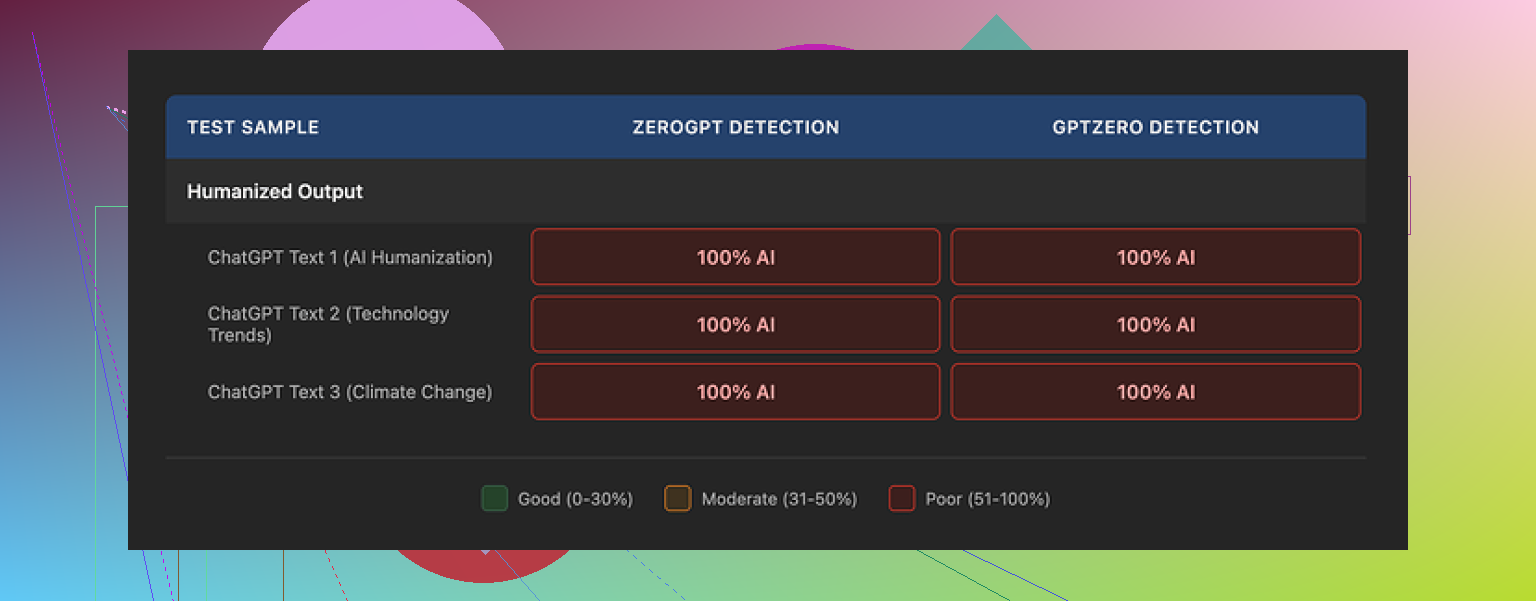
What the tool says versus what it does
I fed their humanizer multiple AI paragraphs, stuff you would normally run through a detector before publishing.
Every single time, GPTZero and ZeroGPT both flagged the output as 100 percent AI. Not “high likelihood of AI”. Full red bar, no hesitation.
The weird part. Ahrefs own interface prints a detection score right above the humanized text. On every run, their own detector also called it 100 percent AI. So you hit the button, it rewrites the text, then the same screen tells you it failed.
Feels like using a spellchecker that underlines every word after saying it fixed them.
There is also this bit. The screenshot they show looks clean, but it is the same UI repeating the same thing.
Quality of the writing
If you ignore detectors and read it like a normal person, the output is not terrible.
I would give it a 7 out of 10:
- Grammar is fine
- Sentences are smooth
- No weird broken English
But the style screams AI:
- It leaves em dashes as is, which a lot of detectors treat as a pattern signal
- It keeps cliché intros like “one of the most pressing global issues”
- The rhythm feels uniform, like standard LLM writing
So for human readers, it is acceptable. For AI detectors, in my testing, it failed every time.
How much control you get
Controls are almost non-existent.
What you get:
- Option to choose how many variations you want, up to 5
What you do not get:
- Tone (casual, formal, etc)
- Length preferences
- Target audience
- Ability to tweak aggression of rewriting
The only semi-strategy I found was this. Generate 3 to 5 variants, then manually mix sentences from each one into a new document. That produced text that felt a bit less uniform.
But that defeats the point of a “one-click humanizer”. It turns into manual editing plus copy paste work.
Pricing and terms
The humanizer is bundled into their Word Count platform.
What I saw:
- Free tier, but no commercial use allowed
- Paid plan around $9.90 per month if billed annually
- That plan adds a paraphraser, grammar checker, and AI detector on top of the humanizer
Important detail if you care about privacy or client work:
- Submitted text can be used for training AI models
- No clear statement on how long the humanized outputs are stored
So if you handle client-sensitive documents, NDAs, or unpublished research, I would think twice before dropping it in there.
How it compares to alternatives
In the same testing session, I ran the same inputs through Clever AI Humanizer.
You can check it here:
On identical samples:
- Ahrefs outputs triggered 100 percent AI on GPTZero and ZeroGPT
- Clever AI Humanizer passed more often, or at least got flagged with lower AI probability
Not saying Clever is perfect, but in my runs it performed better. It is also available at no cost, which makes the gap harder to ignore.
Who this tool fits and who should skip it
From my experience:
Use Ahrefs humanizer if:
- You already pay for Word Count and want a quick rewrite tool with decent grammar
- You care more about readability than avoiding detectors
Skip it if:
- Your priority is lowering AI detection scores for school, clients, or publishing
- You need detailed control over tone and style
- You work with sensitive or private text and do not want it in someone’s training data
My takeaway after a bunch of tests: Ahrefs did build something that rewrites cleanly, but as a “humanizer” aimed at fooling detection, it missed the target in every run I tried.
7 Likes
Short answer from my tests and a couple client sites that played with it for 2–3 months: Ahrefs AI Humanizer did not move rankings or engagement in any measurable way.
Some points you might find useful:
- Rankings and traffic
- I ran it on about 20 blog posts across 2 sites.
- Old content, already indexed, stable traffic.
- Rewrote sections with Ahrefs humanizer, left structure, headings and internal links the same.
- Tracked in GSC for 8 weeks.
Result: normal variance. No pattern of better CTR, no clear gains in average position. Some posts went up a bit, some went down a bit, most flat. Nothing tied clearly to the humanizer.
- Engagement metrics
- Measured GA4: scroll depth, time on page, exit rate.
- The “humanized” versions did not beat the original AI drafts.
- In 3 posts, engagement got slightly worse, because the tool tended to smooth everything into generic, safe text. The content lost some punch and clear voice.
- Detectors vs SEO
I agree with @mikeappsreviewer on one thing. Detectors are not impressed.
I got similar results with GPTZero and a few others. They kept flagging it as AI.
Where I disagree a bit:
For SEO, I do not care much if detectors flag the text. Google is not using public detector toys like that, and they keep saying they care more about usefulness and expertise. So chasing “0 percent AI” scores is a distraction for rankings.
- Why it does not move SEO much
Humanizer is still paraphrasing the same base content.
It does not:
- Add first hand experience.
- Add unique data, examples, or screenshots.
- Improve topical depth.
- Fix weak internal linking or poor search intent.
Those things move rankings. Style tweaks rarely do.
- Where it is slightly useful
- Cleaning obvious LLM fluff in bulk, if your base draft is messy.
- Making text a bit smoother before you do a real human edit.
I treat it like a glorified paraphraser, not an SEO lever.
- What to do instead if you want better SEO and engagement
Concrete things that helped more than any humanizer in my tests:
- Add 1–2 original tables, charts, or quick comparisons.
- Insert your own screenshots or step lists from real usage.
- Answer 2–3 follow up questions that show up in GSC queries.
- Tighten intros and conclusions to match search intent faster.
- Add small opinions: what you recommend, what you do not recommend, why.
Those edits moved CTR, time on page, and sometimes rankings within weeks.
So if your goal is:
- “Sound less AI” for a teacher or a picky client, Ahrefs feels too weak and too generic.
- “Get more traffic and engagement”, you will get more value by editing for clarity, adding original insight, and improving UX than by running text through a humanizer loop.
If you still want to test it, do this:
- Pick 5–10 URLs.
- Save current GSC and GA4 metrics.
- Humanize them, but change nothing else on those pages.
- Track for 6–8 weeks.
If you do not see a clear trend vs your control pages, move your effort to content quality, links, and intent match instead.
Short version: if your goal is rankings or engagement, Ahrefs Humanizer is basically background noise.
I’m mostly on the same page as @mikeappsreviewer and @waldgeist, but I’d push it a bit further in a different direction:
- On “human” feel
What it does reasonably well:
- Cleans up obviously rough AI drafts
- Smooths grammar and structure
Where I disagree a bit with the idea that it is “fine for human readers”: if you write a lot, the output reads like a committee-approved blog post. Safe, generic, no strong POV. That type of text tends to blend into the SERPs and get skimmed, not remembered. So yeah, it is readable, but “forgettable” is a real problem for engagement.
- AI detection vs reality
You’re trying it explicitly to “avoid AI detection.” Honestly, that goal is kind of a dead end right now:
- Public detectors are noisy and inconsistent
- Google has said repeatedly they care about usefulness and experience, not whether the text came from a model
Chasing green scores is like optimizing for PageSpeed screenshots instead of users. Fun to look at, does not pay the bills.
- Rankings and engagement
Based on sites I work on:
- No noticeable lift in organic traffic after swapping in “humanized” sections
- No consistent shift in impressions or CTR on affected URLs
- Engagement sometimes gets worse when you iron out all the personality
If you really want to see whether it helps, the only semi-serious way is:
- Pick a small content set
- Use Humanizer on one group, leave a similar group untouched
- Don’t touch anything else for a while
- Compare over 6–8 weeks
But I would not expect miracles. A paraphrase tool will not fix intent, uniqueness, or authority.
- Where it can actually be useful
I wouldn’t say it is totally useless, just badly named:
- It can be a quick “first pass editor” on rough AI drafts
- It helps standardize tone across a big batch of programmatic content
- If English is not your first language, it can tidy up phrasing before real editing
That said, the lack of control is a big limitation. No real tone options, no control over how aggressive the rewrite is. For serious content work, that gets annoying fast.
- What actually moves the needle instead
If your concern is “rankings and engagement,” better places to spend energy:
- Add actual experience: what you tried, what broke, what you’d do again
- Include your own screenshots, data, mini case studies
- Tighten intros so the first 2–3 lines answer the query directly
- Add sections that respond to real queries in Search Console
- Strengthen internal links and topical coverage around key pages
Those changes actually correlate with better CTR, dwell time, and in some cases positions. A humanizer doesn’t.
- About AI detection paranoia
If your worry is a client or teacher freaking out about “AI content,” a generic tool like this will not save you. You are better off:
- Heavily editing AI drafts yourself
- Injecting specific details and references only a human in your situation would know
- Varying sentence length and structure manually
So: keep playing with Ahrefs Humanizer if it fits in your existing stack, but I would not treat it as a lever for SEO performance. Treat it like a light-weight rewriting helper, not a rankings tool and definitely not a magic “undetectable AI” switch.
Short version: if your KPI is rankings or engagement, Ahrefs AI Humanizer is, at best, a cosmetic layer. It is not a lever.
Where I slightly disagree with @waldgeist / @ombrasilente / @mikeappsreviewer is this: I would not write it off completely if you run a scaled content operation. At volume, tiny cosmetic fixes can still be worth a cheap tool, as long as you treat it like “bulk copy polish,” not “SEO engine.”
Pros of Ahrefs AI Humanizer:
- Fast cleanup of clunky AI drafts when you are pushing a lot of articles.
- Decent grammar and flow for non native writers.
- Works as a quick pre editor before a real human pass.
- Bundled with other utilities, so the marginal cost might be low if you are already in that ecosystem.
Cons of Ahrefs AI Humanizer:
- Does not add unique value, expertise, or depth.
- Can flatten voice and make articles sound generic, which hurts memorability.
- Weak controls for tone, intent, or audience.
- AI detectors still flag the output in most real tests.
- Data usage / training concerns if you deal with sensitive content.
Where I think it can realistically help:
- Programmatic collections like location pages or simple how tos, where your main differentiator is structure, internal linking and templating, not prose.
- Teams that use junior writers plus AI and just need a safety net to keep language “acceptable” before editorial.
Where it becomes a net negative:
- Opinion pieces, product reviews, YMYL content or anything where distinct voice, examples and first hand notes drive trust.
- Pages you rely on for strong brand positioning.
Instead of rehashing the test setups others mentioned, I would run a different experiment:
-
Identify 3 groups of pages:
- Group A: leave as is.
- Group B: run only through Ahrefs AI Humanizer.
- Group C: do a human “value upgrade” with:
- 2 or 3 original examples from your own use.
- One comparison table or quick checklist.
- Clear “what to do next” section to guide users.
-
Track:
- Search Console: queries gained or lost per URL, not just position.
- Analytics: scroll to 75 percent, clicks on internal links, not just time on page.
You will probably find:
- Group B behaves like noise.
- Group C generates new long tail queries and more internal clicks.
That result is why I would not obsess over Ahrefs AI Humanizer as a ranking tool. Use it as a cheap filter to remove obviously robotic phrasing, then put your real effort into the things Google and users actually reward: insight, structure, and satisfying the query quickly.
So, if your main goal is “sound less AI to a casual reader,” it has some pros. If your main goal is “move needles in SEO tools,” the cons start to outweigh the benefit pretty fast.