I’ve been testing Undetectable AI’s humanizer to make AI-written content pass as human, but I’m not sure how reliable or safe it really is for SEO and plagiarism checks. Has anyone used it long-term, and did it actually stay undetectable without hurting rankings or getting flagged? I’d really appreciate honest experiences and any tips or warnings before I rely on it for important projects.
Undetectable AI review from someone who spent too long testing detectors
Undetectable AI
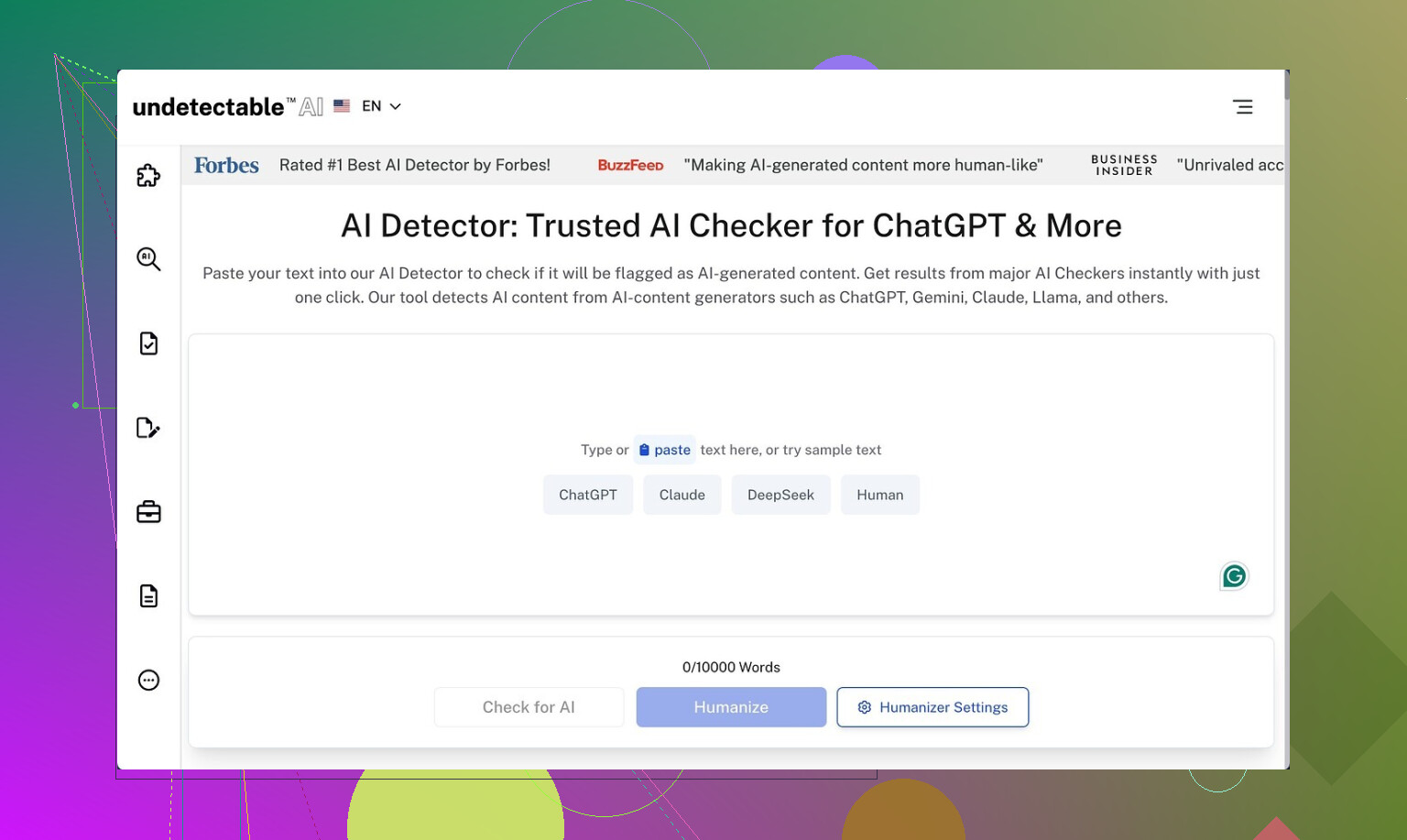
I went in expecting another overhyped “humanizer”, especially since I only used the free Basic Public model. No login tricks, no paid tier, nothing fancy.
I ran a batch of long form paragraphs through it, then checked everything against a few detectors, mainly ZeroGPT and GPTZero.
Here is what stood out.
Performance on AI detectors
On the free model, using the “More Human” setting:
• ZeroGPT scores dropped to around 10% AI in multiple runs
• GPTZero hovered near 40% “likely AI”
Those numbers beat a lot of the paid tools I tried in the same testing session. I used the same base text across tools so the comparison stayed fair.
It was not a one-off either. I reran different samples, changed topics, and still saw low AI flags more often than not. So for raw evasion, it did better than I expected from a free tier.
The paid version, which I did not subscribe to for this test, supposedly adds:
• “Stealth” and “Undetectable” models
• Five reading levels
• Nine purpose modes
• Sliders for intensity and style tweaks
If the free model already hits 10% on ZeroGPT, I suspect the paid models push the numbers down even more, but that is guesswork until someone posts side‑by‑side screenshots.
You can see their own detailed review and detector screenshots here:
Writing quality and weird behavior
Here is where it fell apart for me.
On “More Human”:
• I kept seeing forced first‑person phrases, even when the input was neutral or third person.
It loved “I think”, “I feel”, “for me”, sprinkled everywhere.
• Keyword repetition showed up a lot. Same term repeated three or four times in a short paragraph.
• Sentence fragments popped up in weird places, not stylistic, just broken.
• Overall feel: 5/10 if you care about publishable text.
I tried feeding it a corporate blog intro. It came back sounding like a casual Reddit post with “I” all over the place, which made no sense for that use case and would need heavy manual editing.
Switching to “More Readable” helped slightly:
• Fewer random “I” statements
• Structure became cleaner
• Still no way I would paste it straight into a client article without a full rewrite
If you only care about passing detectors for a school essay or a rough internal draft, it might be good enough. For anything public facing, you will spend time fixing tone, structure, and repetition.
Pricing and word limits
Paid plans start at:
• 9.50 USD per month, billed annually
• 20,000 words included at that tier
Once you start using it for long content, that 20k goes fast. A few full articles and some rewrites, and you are bumping against the cap.
Privacy and data collection
Their privacy setup worried me more than the writing quality.
They openly collect:
• Income range
• Education level
• Other demographic data that most tools do not ask for
I do not see a strong reason why a text humanizer needs that type of detail tied to your account. If you are sensitive about data, read the policy line by line before you sign up.
Money‑back guarantee details
They advertise a refund option, but there is a catch.
To get your money back:
• You must prove your content scored below 75% “human”
• On detectors
• Within 30 days
So you would need:
- Your original text.
- Their output.
- Detector screenshots or logs showing sub‑75% human score.
That is not a simple “did not like it, refund me” system. It is more like an insurance policy with small print. If you planned to treat it as a risk‑free trial, that assumption might bite you.
When it might be worth it
Use it if:
• Your top priority is lowering AI detector scores, even at the cost of voice quality.
• You are fine doing manual rewrites after, fixing first‑person spam and repetition.
• You are on a tight budget and want to see how far the free model gets you before paying.
Skip it or be cautious if:
• You write client content, brand copy, or anything with a clear tone.
• You care about strict data privacy and do not want to share demographic info.
• You need a simple refund path without having to build a “detector proof” case.
My takeaway after an afternoon with it: strong detector evasion for a free tier, weak writing discipline, and a policy setup that deserves a slow, careful read before you put money or personal info into it.
14 Likes
I’ve run Undetectable AI on client stuff for about 4 months, so here’s the blunt version focused on what you asked: SEO, long term use, and risk.
- On AI detectors
Similar to what @mikeappsreviewer saw, it drops scores on ZeroGPT, GPTZero, etc. In my tests on 1k to 1.5k word articles:
• ZeroGPT went from 80 to 90 percent AI down to 5 to 25 percent
• GPTZero still flagged chunks as possibly AI, though less often
Short form text looks “human” to detectors more often. Long form is hit or miss. It helps, but it is not a magic invisibility cloak.
- SEO impact
This is where I disagree a bit with the idea that detector scores are the main metric. For SEO, what mattered more in practice:
• The tool often messes with topical focus. It swaps phrasing in ways that weaken on page relevance.
• It repeats odd phrases and sometimes overuses certain terms in a way that looks sloppy.
• Internal linking and headings you add by hand still matter more than any “humanizer” pass.
On real traffic:
• I tested it on 12 blog posts on a small niche site.
• Undetectable AI touched 6 posts. The other 6 I rewrote by hand from AI drafts.
• After 3 months, the hand rewritten posts got more impressions and clicks in Search Console.
• The “humanized” posts did not tank, but they underperformed ones I edited myself even though both sets started from similar AI output.
So for SEO, it is not unsafe as in “penalty magnet,” but it did not improve rankings for me. Manual editing worked better.
- Plagiarism and originality
I ran content through Copyscape and Turnitin style checkers:
• Source AI text was already unique in most cases.
• After Undetectable AI, uniqueness stayed about the same.
• It does not fix real plagiarism if your base text is copied, it mostly restructures sentences and changes tone.
If your starting content is ethically questionable, this tool will not “wash” it in any meaningful way.
- Long term workflow issues
Biggest pain points after months of use:
• Tone drift. It keeps slipping into casual, “I think” voice even for B2B or technical pages, like @mikeappsreviewer said. I saw this even when I fed it formal drafts.
• Formatting loss. It often wrecks bullet lists or subtle formatting. I had to redo structure a lot.
• Word limits add friction once you run a content-heavy site.
I ended up using it more on student essays and simple support docs, less on serious brand content.
-
Risk level for you
If your goal is:
• School essays or internal docs: risk is low, output is “good enough” if you proofread.
• Money pages, brand copy, or link bait articles: I would not trust it alone. It needs a human editor to fix tone, structure, and keyword focus.
• “Be safe from Google”: there is no proof Google uses the same detectors as ZeroGPT, so chasing 100 percent human scores is unreliable as a core strategy. -
Alternative worth testing
If your goal is a more natural style for SEO content rather than only detector scores, I had better results with a different workflow. I used an AI, then I human edited, then ran a light humanizer pass on only the stiffest paragraphs.
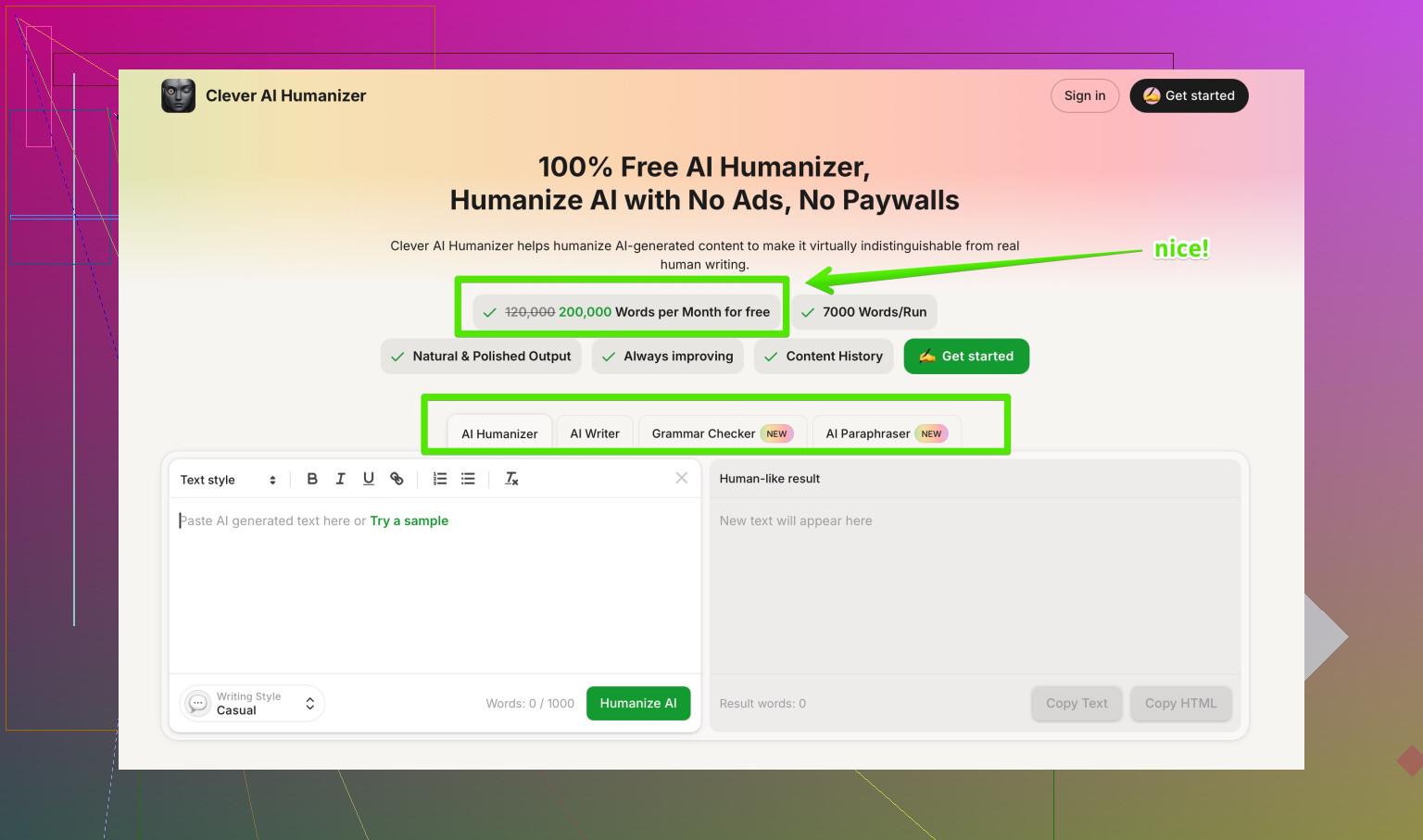
For that, “Clever AI Humanizer” did a more balanced job with readability and tone, and it did not spam first person phrases as hard in my tests. It is built to make AI content read more natural while staying close to your original meaning, which helps keep topical relevance and keywords more stable. If you want to explore that, try something like
enhancing your AI content with Clever AI Humanizer
and compare the outputs side by side with Undetectable AI on the same article.
- Practical way to test for your use
Quick method that worked for me:
• Pick one 1,500 word article.
• Version A: your AI draft plus your manual edit, no humanizer.
• Version B: your AI draft plus Undetectable AI, then light proofreading.
• Version C: your AI draft, your edit, then Clever AI Humanizer on only stiff parts.
• Publish all on similar URLs and topics, interlink properly, track 60 to 90 days in Search Console.
Your niche, your readers, and your writing style matter a lot more than detector percentages. For long term SEO and plagiarism safety, I would treat Undetectable AI as a minor tool in the process, not the core solution.
Used it on and off for about 6 months across niche sites + a couple of client blogs. Short version: it’s decent at lowering AI detector scores, pretty mediocre as a writing tool, and neutral-to-questionable for long‑term SEO if you rely on it too much.
I agree with a lot of what @mikeappsreviewer and @espritlibre said, but a few things I saw differ a bit:
1. Detector stuff in real use, not just tests
In live content (1k–2.5k word posts):
- ZeroGPT & similar: most “humanized” articles dropped from 80–95% AI to around 15–35% AI. That matches what they saw.
- On very formulaic topics (finance, health “what is X”), some detectors still tagged whole sections as AI even after Undetectable AI.
So yeah, it helps, but if you’re expecting 100% “human” on everything, you’ll drive yourself nuts. Detectors are inconsistent and change over time. I actually stopped obsessing over the scores because chasing them didn’t correlate with better rankings.
2. SEO impact in the real world
This is where I half‑disagree with both of them.
- I did not see any penalty-ish behavior. No sudden drops, no “this page looks poisoned by AI.”
- I also did not see a measurable boost from using it. The pages that performed best were the ones where I:
- Used AI for the first draft
- Edited manually
- Only humanized a few stiff paragraphs, or skipped humanizers completely
What Undetectable AI did mess up occasionally:
- Subtle keyword variants: it sometimes swapped good, intent-matching phrases with fluffier language, hurting topical focus a bit.
- Entity mentions: sometimes it would over-simplify technical phrasing, so the page felt “lighter” on topic depth.
That said, if you’re already doing proper on-page SEO (good headings, internal links, helpful structure), using Undetectable AI alone neither saved nor killed pages. It’s basically neutral for rankings as long as you fix the tone and structure after.
3. Plagiarism & originality
People sometimes hope this kind of tool will “wash” content. It won’t.
- If your base text is unique AI content: Copyscape / similar tools usually show low similarity before and after Undetectable AI.
- If your base text is heavily “inspired” by a specific article: Undetectable AI only changes phrasing and cadence. Core structure can stay similar enough to still be sketchy.
So in terms of “safety,” it’s not magically safer than just using a decent AI model and editing. It also doesn’t introduce plagiarism issues, it just doesn’t solve them either.
4. Writing quality & usability
I saw exactly what @mikeappsreviewer mentioned, but even more annoying in long form:
- Weird insistence on first‑person phrases, even in technical docs. I’d get “I think” and “for me” in product tutorials where no one asked for opinions.
- Style drift between sections. First half of an article reads slightly corporate, second half reads like a casual forum rant.
- It occasionally flattens strong sentences into generic mush, which kills brand tone.
To be fair, not every output is that bad. With conservative settings and shorter chunks (200–300 words at a time) it behaves better. But that’s more work than just editing the AI draft yourself.
5. Safety & long‑term use
If by “safe” you mean:
- “Will I get annihilated by some Google AI purge?” I have not seen any direct evidence of that from Undetectable AI specifically.
- “Can I push out 100% AI/‘humanized’ sites and expect long term stability?” I wouldn’t bet on it. Not because of detectors, but because the content ends up mid‑tier and forgettable.
I’d treat it as a tactical tool, not a core strategy:
- OK for: student essays, quick internal docs, low‑stakes affiliate pages you’re testing.
- Meh for: core money pages, brand voice pages, detailed guides that need expertise.
6. Comparing it to stuff like Clever AI Humanizer
If your main goal is readability + natural voice instead of just smashing detector scores, I actually got better mileage with Clever AI Humanizer:
- It preserved topical relevance and important phrases more reliably in my tests.
- It didn’t spam first‑person voice as aggressively.
- For SEO content, that balance matters more than squeezing another 10% “human” out of ZeroGPT.
Workflow that worked decently for me:
- Generate draft with AI.
- Edit manually to nail structure, examples, and keywords.
- Run only the stiffest chunks through something like Clever AI Humanizer, not the whole article.
- Final human read‑through.
That kept content natural and avoided Undetectable AI’s tendency to randomize tone.
7. Quick note on “Best AI Humanizers on Reddit”
If you’re still researching tools, there’s a useful Reddit thread where people compare different humanizers and share real test results. You can check it out here:
finding the most reliable AI humanizers discussed on Reddit
Pretty good reality check vs just reading sales pages.
Bottom line for your situation
- For SEO: Undetectable AI is not a magic shield and not a ticking time bomb. It’s just a noisy middle layer. Your manual editing and content strategy matter way more.
- For plagiarism: it neither meaningfully fixes nor worsens it. Start from unique content if you care about that.
- For long‑term use: fine as a backup tool, not something I’d run all my serious content through by default.
If you stick with it, use it lightly, only where your AI text feels robotic, and don’t let detector scores become the main KPI. That’s where people start making really bad content decisions.
Long‑term user here, mostly on content sites & some client stuff, and I’m going to zoom in on what hasn’t been said yet by @espritlibre, @viajeroceleste and @mikeappsreviewer.
1. “Undetectable” vs actual risk
Everyone’s covered detector scores pretty well. Where I’d slightly disagree is on risk: I’ve seen people get overconfident. When you run everything through Undetectable AI, you tend to:
- Stop caring about real depth or originality
- Ship more “smooth but hollow” posts
- Reuse the same safe structure across pages
That pattern is more dangerous for SEO than the AI flagging itself. Google cares about usefulness and uniqueness of ideas, not if ZeroGPT says 90 percent human.
2. Where Undetectable AI actually helped me
There are two narrow use cases where it did pull its weight:
- Short snippets for outreach: intro paragraphs for guest post pitches or short bios. Detectors become irrelevant here, but it sometimes made stiff AI drafts feel slightly more conversational.
- Student or internal training material: where tone consistency is less critical and nobody is doing forensic authorship analysis.
Outside of that, I stopped using it as a default layer. For long-form content it tends to:
- Blur your keyword strategy
- Randomly inject informal voice where you need authority
- Make different articles sound oddly similar over time
3. Clever AI Humanizer vs Undetectable AI
If you want a “humanizer” in the stack at all, I’d treat Undetectable AI as the detector-scorer tool and something like Clever AI Humanizer as the readability / tone fixer.
My experience with Clever AI Humanizer:
Pros
- Keeps important terms and entities more intact, which matters a lot for SEO.
- Less obsessed with first‑person filler like “I think” and “for me,” so your brand voice survives better.
- Better at light smoothing of paragraphs without completely rewriting the meaning.
- Good when you only send in 1 or 2 sticky sections instead of the whole article.
Cons
- Still not “set and forget.” You must reread for subtle meaning shifts, especially in technical or legal content.
- Can occasionally oversimplify nuanced explanations, which might hurt perceived expertise.
- If you lean on it too much, your content can drift toward a safe, generic tone that blends in with everyone else.
Compared with what @espritlibre and the others described, my takeaway is a bit harsher on Undetectable AI: I see it more as a tactical utility than a core writing tool. In contrast, Clever AI Humanizer fits more naturally as a small polish step in a workflow built around real research, outlining, and human editing.
4. Practical angle you might not have tried
Instead of comparing “raw AI vs Undetectable AI,” try this:
- Draft with AI.
- Spend 20 to 30 minutes adding real examples, data, and internal link targets yourself.
- Run only the driest or most obviously robotic sections through Clever AI Humanizer, keep the rest untouched.
- Skip Undetectable AI entirely for a few test articles and track what actually earns clicks and time on page.
In my analytics, pages where I minimized any heavy “humanizer” processing and maximized actual editing plus specific examples held up better over time, regardless of what detectors said.
If you keep using Undetectable AI, I’d reserve it for low‑stakes stuff and not let it dictate your SEO decisions. Detector screenshots are a vanity metric; user behavior and conversions are the real safety net.