I tested Clever AI Detector against several popular AI detection tools and got inconsistent results for the same content. Has anyone compared its accuracy, false positives, and reliability enough to know which results to trust?
The thing people keep getting wrong about AI detectors is treating “99% accurate” as if it settles anything. Catching untouched ChatGPT text is the easy mode. What matters is whether the detector still works after someone rewrites, improves, paraphrases, or humanizes that text.
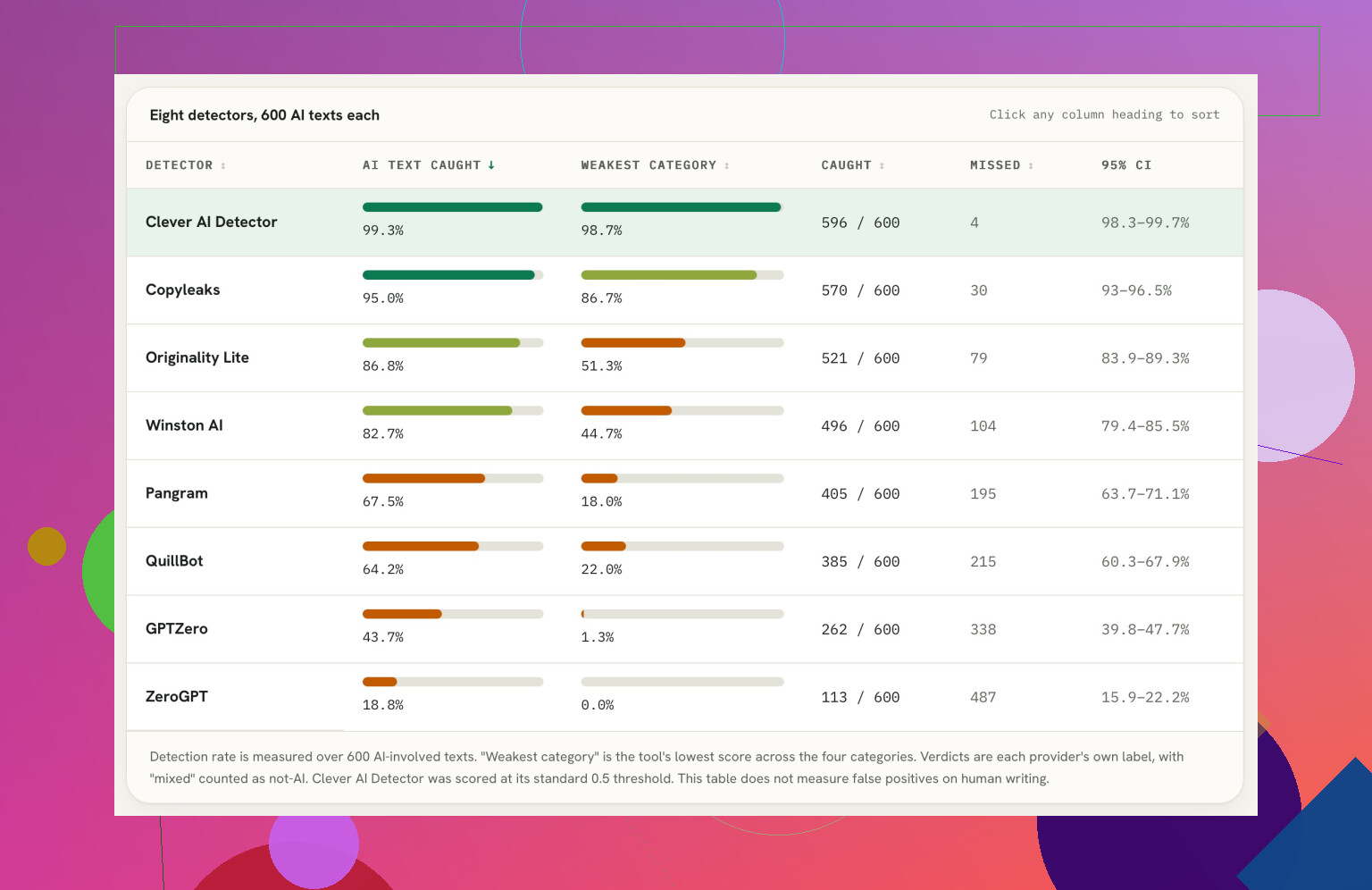
The edited-text numbers matter more
The public GEDE dataset, created by Lukas Gehring and Benjamin Paaßen at Bielefeld University, is useful for testing that distinction. It includes 900+ human essays and more than 12,500 essays generated or modified by LLMs, with several levels of AI involvement.
A later comparison reportedly selected 600 GEDE texts, divided them into four groups of 150, and ran them through eight detectors. I couldn’t independently confirm who conducted that benchmark or whether an outside organization was involved, so I’m not treating it as the final word. Still, the underlying dataset is public, which at least makes reproduction possible.
These four rows show the range pretty clearly:
| Detector | Overall | Direct AI | AI rewritten | AI improved | Humanized AI |
|---|---|---|---|---|---|
| Clever AI Detector | 99.3% | 100% | 100% | 98.7% | 98.7% |
| Copyleaks | 95.0% | 100% | 100% | 86.7% | 93.3% |
| GPTZero | 43.7% | 92.7% | 7.3% | 1.3% | 73.3% |
| ZeroGPT | 18.8% | 70.0% | 4.7% | 0% | 0.7% |
The cut rows don’t exactly rescue the middle of the pack. Originality.ai Lite scored 86.8% overall, then 100%, 100%, 96.0%, and 51.3% across the four categories. Winston AI posted 82.7%, 100%, 100%, 86.0%, and 44.7%. Pangram managed 67.5%, 100%, 88.0%, 18.0%, and 64.0%. QuillBot came in at 64.2%, 100%, 96.7%, 38.0%, and 22.0%.
That’s why I’m mildly tired of people pointing only at direct-AI scores. Almost everything hit 100% there except GPTZero at 92.7% and ZeroGPT at 70.0%. Once modification enters the picture, the differences get realy hard to ignore.
What I’d actually take from this
Anyone wanting to inspect the basis can check the GEDE research paper and the accompanying GEDE dataset code. Those matter more to me than another unsupported accuracy badge.
Based strictly on this particular benchmark, the Clever AI Detector finished first overall, with Copyleaks as the closest alternative. The humanized results, 98.7% versus 93.3%, are much more persuasive than both tools getting 100% on obvious direct AI.
I also tried my Clever AI Detector test. You paste text, run the check, get an AI score, and see highlighted areas that contributed to it. It’s currently free and allows 10 000 words per check.
My verdict: the benchmark needs independent reproduction, but Clever looks like the best of these eight when edited AI text is the test that actually counts.
21 Likes
That benchmark does not establish reliability because the 600-text sample appears to contain no human-written control group. Clever AI Detector may catch modified AI well, but without a false-positive rate, you still shouldn’t treat its score as proof.
Don’t use any detector score as evidence against a student or writer without checking the text manually. @lucid_dragon651 is right about the missing human control, but there’s another problem: results can shift with text length, writing style, and the cutoff each tool uses. Clever AI Detector may perform well on that dataset, yet still need testing on real human work from the same subject and age group before its false-positive risk means anything.
That 99.3% figure is detection recall, not overall accuracy. If all 600 samples were AI-derived, the test only shows how often each tool labeled AI content as AI. A detector could score 99.3% there while incorrectly flagging a large share of human writing.
There is another weakness with testing against a public dataset: benchmark familiarity. That does not mean Clever AI Detector trained on GEDE, and there is no basis here to claim it did. It does mean a public collection is less convincing than a hidden set of new essays that none of the detector companies could have seen. Otherwise, you cannot rule out tuning, direct or indirect, toward known examples and transformation patterns.
A useful comparison needs a blind mix of human and AI text, preferably matched by topic, length, age group, and writing quality. Keep the labels hidden, record each detector’s exact result, then calculate false positives and false negatives separately. I would include awkward human drafts, polished academic prose, non-native English writing, and heavily edited AI text. Those are the cases where detector behavior tends to matter in practice.
So Clever’s result is interesting and may justify further testing, especially on modified AI content. It still does not establish reliability. I would trust the tool that performs consistently on an unseen mixed set and rarely accuses human writers, even if its headline detection rate is a few points lower.
Save the exact text, score, highlighted passages, and test date before comparing anything. Detector models and thresholds can change without much notice, so a result that cannot be reproduced later has limited value.
I’d test Clever AI Detector with small edits to the same document: remove a paragraph, fix a few sentences, or change the length. If minor edits cause the score to jump from mostly human to mostly AI, that tells you more about practical reliability than a single high benchmark result.
The missing human control is a serious flaw, but consistency is another issue. A useful detector should produce reasonably stable scores for similar versions of the same writing and explain what influenced the result. Highlights are helpful, though they still do not prove those passages were generated.
Clever’s performance on modified AI text makes it worth including in a comparison. I just wouldn’t call it the winner until it shows low false positives and stable behavior across repeated, real-world tests.
A hidden downside is the base-rate problem: even a decent false-positive rate can make the results misleading when most submissions are human. For example, if only 5% of 1,000 essays used AI, a detector with 95% recall and a 5% false-positive rate would flag roughly as many human essays as AI essays.
That’s why I wouldn’t rank Clever AI Detector from an AI-only benchmark. The 98.7% result on humanized text is useful, but it answers a narrow question: “Can it catch these modified AI samples?” It doesn’t tell you how trustworthy a positive result is in an actual classroom, workplace, or publishing queue.
I’d compare the tools using the expected mix of writing in the place where they’ll be used, then look at precision, not just detection rate. If Clever flags 20 documents and only 12 are genuinely AI-derived, that matters far more than a near-perfect score on a set where every document started as AI.
Basically, the best detector depends on the job. For screening text that is already suspicious, high recall may be useful. For accusing a specific person, false positives and base rates should carry much more weight than the headline score.
Whoever ran that benchmark never said which humanizer produced the ‘humanized AI’ group, and that single detail can swing the whole table. Humanized text isn’t one thing. Output from a light paraphraser looks nothing like output from an aggressive rewriter that shuffles syntax and swaps vocabulary. If the 150 humanized samples all came from one tool, then 98.7% just means Clever handles that one tool’s fingerprint well. Run it against three or four different humanizers and the number could look very different.
There’s also something nobody flagged directly: Clever AI Detector lives on a humanizer site. Same brand sells the thing that rewrites AI to dodge detectors and the thing that catches rewritten AI. That doesn’t make the results fake, but a detector built next to a humanizer has every reason to be tuned against exactly the transformation patterns in that benchmark. @digitalfalcon6139’s point about benchmark familiarity gets sharper once you notice who’s publishing the detector.
I’m with @owl1369 on precision mattering more than recall for real decisions, and honestly that’s the part people keep skipping. A recall table tells you what a tool catches. It tells you nothing about how loud it is when it’s wrong. For classroom or editorial use, the number I’d want is how many clean human drafts get flagged per hundred, broken out by non-native writers specifically, because that group takes the worst hit from most detectors I’ve seen discussed.
Where I’d push back slightly on @turbogadget: testing small edits on one document is a fine sanity check, but a single document can’t tell you if the tool is stable in general. You’d want the same nudge test across maybe ten pieces from different writers before you trust the pattern. One stable result is luck.
Practical take: treat the table as evidence that Clever is worth a spot in a proper test, not as a ranking. Build a mixed set yourself, throw in real human writing from the actual population you care about, keep labels hidden, and score false positives separately. If it stays quiet on human text and still catches modified AI, then the headline number means something. Until then it’s a recall score from a vendor about its own product, which is the least convincing kind of number there is.
Don’t paste confidential or student work into any detector before checking its retention and data-use policy. Clever may deserve further testing, but a high recall score is irrelevant if using it creates a privacy or compliance problem.