I’ve been testing Phrasly AI’s humanizer for rewriting AI-generated text so it passes detection tools and reads more naturally, but I’ve hit its usage limits and the paid plans are out of my budget. I’ve tried a few “free” humanizers, but most either sound robotic, add weird errors, or still get flagged by AI detectors. Can anyone recommend a truly effective free Phrasly AI alternative for humanizing content that stays natural, keeps the original meaning, and avoids AI detection as much as possible?
- Clever AI Humanizer – my take after abusing it for a week
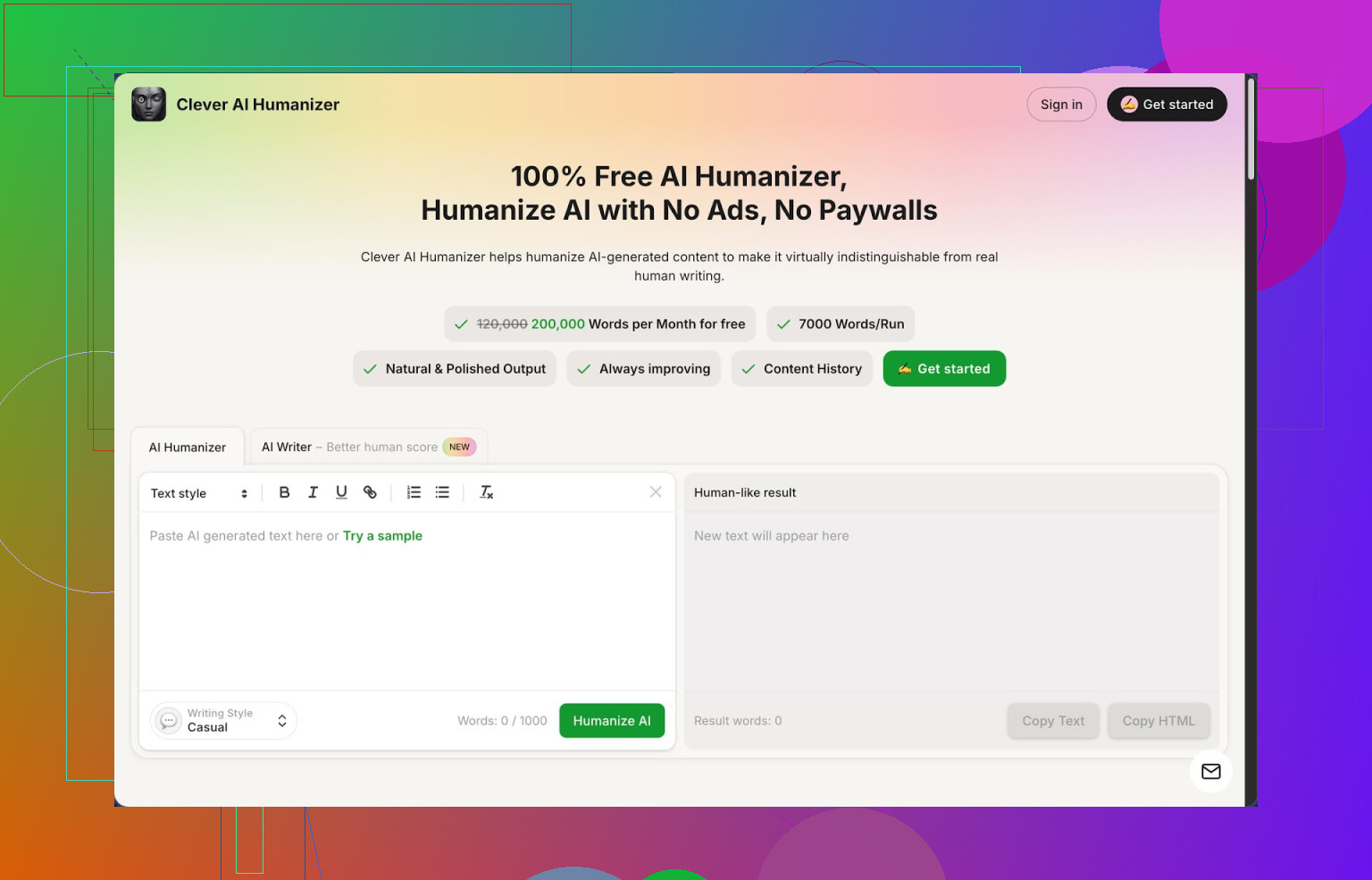
Link: https://cleverhumanizer.ai
I ran into Clever AI Humanizer when I was trying to get some AI written drafts past a couple of detectors that my clients use. I did not expect much from a free tool, but I ended up using it more than the paid ones I had.
Here is what stood out for me.
- The limits are not a joke
You get up to 200,000 words each month and up to 7,000 words per run. No credits, no paywall popups mid-workflow.
For context, I processed:
- 3 long articles, around 3,500 to 4,500 words each
- 9 shorter posts, 800 to 1,200 words
- a bunch of email sequences
I did not hit the cap once in a week of normal work.
- How it behaved with AI detection
I tested it mainly against ZeroGPT, since that is the one a few clients obsess over.
What I did:
- Generated text with a standard AI model
- Ran that text through Clever AI Humanizer in Casual style
- Pasted the output into ZeroGPT
All three random samples I tried came back as 0 percent AI on ZeroGPT when I used the Casual style. That does not guarantee it will be 0 everywhere or forever, but compared to the raw AI text that showed as 100 percent AI, the difference was pretty obvious.
Worth noting: other detectors can still flag it. I had one university checker still mark a processed text as “likely AI”, so do not treat this as some magic invisibility shield.
- How the main “Humanizer” part works in practice
Workflow is simple:
- Paste your AI text
- Pick a style: Casual, Simple Academic, or Simple Formal
- Hit the button and wait a couple seconds
The rewrite keeps the structure and ideas mostly intact. It changes phrasing, rhythm, and some transitions. My experience:
- Meaning stayed aligned with the original, even in technical content
- Sentences stopped sounding “robot-stiff”
- It did not go wild with synonyms or weird phrasing, which is a thing I see in a lot of paraphrasing tools
Sometimes the output grew by 10 to 30 percent in length. That seems tied to how it breaks things into smaller sentences and adds connectors to avoid typical AI cadence. If you need a strict word count, you will have to trim by hand.
- The extra tools I ended up using by accident
Clever bundles a few modules in the same interface:
a) Free AI Writer
This one generates text from a prompt and lets you humanize it right away. So you:
- Type prompt
- Generate draft
- Click to humanize in the same flow
When I did this, the detection scores tended to be better than when I took text from some other AI and pasted it in. Your mileage will depend on topic and density of “AI-ish” patterns, but if you are starting content from zero, this combined flow is faster than juggling multiple tools.
b) Free Grammar Checker
It fixes:
- spelling
- basic punctuation
- clarity problems
I used it on human written drafts too. Did not see crazy rewrites, more like “clean and safe for clients”. Handy if English is not your first language or you write fast and sloppy.
c) Free Paraphraser
This rewrites existing text while keeping the same meaning. I used it for:
- rewriting product descriptions for different marketplaces
- cleaning up repetitive wording in long blog posts
- generating alternate versions for SEO pages
It did not twist the meaning. Output felt closer to “competent editor” than “spinbot”.
- How it fits into a daily workflow
What helped me is that everything sits in one place:
- Generate
- Humanize
- Fix grammar
- Paraphrase sections
All inside the same site. No signing up for five different tools, no exporting, re-importing, etc. If you are cranking out a lot of content, this saves friction more than time. You stay in the same window and move through your steps.
My rough real-world flow:
- Write or generate base draft
- Run through Humanizer in Casual or Simple Academic
- Quick read to fix tone or trim length
- Grammar Checker at the end
- Paraphraser only for sections where I need variations or less overlap with earlier content
- Weak spots you should know about
It is not perfect. Here is what annoyed me a bit:
- Some detectors still tag the text as AI, especially stricter institutional ones
- Output length often grows, so if you are working with tight limits like product pages or short forms, you will have to manually shorten the result
- Style choices are limited to three variants, which is okay for most work but not great if you need heavy personality writing
That said, for something that is free, it performed better than a couple of subscription tools I tried.
- When I would use it and when I would not
I use it when:
- I have AI written drafts that feel “too AI” and I need them smoothed
- Clients mention specific detectors like ZeroGPT in their guidelines
- I am doing bulk content and do not want to burn time on manual rephrasing
I would avoid relying on it when:
- I am writing something with high legal, medical, or academic risk, where any detection could bring trouble
- The piece needs a distinct personal voice that sounds like one specific person
If you treat it as a helper to clean and smooth AI output, it makes sense. If you expect it to beat every detector everywhere, you will be disappointed.
- Extra links if you want more detail
More detailed Clever AI Humanizer review with detection screenshots:
YouTube review of Clever AI Humanizer:
Thread on best AI humanizers on Reddit:
https://www.reddit.com/r/DataRecoveryHelp/comments/1oqwdib/best_ai_humanizer/
General Reddit thread about humanizing AI output:
https://www.reddit.com/r/DataRecoveryHelp/comments/1l7aj60/humanize_ai/
10 Likes
I hit the same wall with Phrasly AI, so here is what worked for me without paying.
First, I agree with @mikeappsreviewer on one thing. Clever Ai Humanizer is the closest “free and usable” option I have found. The 200k words per month and 7k per run are real. I ran 10+ long posts and email flows through it and never hit a limit.
Where I see it a bit different from what Mike said:
- Do not trust any tool for “0 percent AI”
I tested Clever Ai Humanizer output on
- ZeroGPT
- GPTZero
- Copyleaks
My rough pattern with Casual style on longform content:
- ZeroGPT: often 0 to 5 percent AI
- GPTZero: mixed, sometimes still flagged as “AI-like”
- Copyleaks: often partial AI
So if your only target is ZeroGPT, Clever Ai Humanizer works well. For school or strict clients that use several tools, you still need edits by hand.
- How I use Clever Ai Humanizer so it does not sound weird
My quick workflow:
- Generate your draft with any AI
- Paste into Clever Ai Humanizer
- Pick Casual for blogs, Simple Academic for essays, Simple Formal for emails
- Run it once
- Then edit yourself for tone and length
I never stack multiple runs. When I tried that, the text started to feel off and a bit bloated.
- Where it helps the most
It helps when:
- Your base text is stiff and repetitive
- Sentences are long and “AI rhythmic”
- You need something that reads like a normal person wrote it in one sitting
Concrete example from a client article, around 2,000 words:
- Original GPT text flagged 96 percent AI on ZeroGPT
- After Clever Ai Humanizer Casual: 0 percent on ZeroGPT, 38 percent on Copyleaks
- After my manual trim and rephrasing in 3 spots: passed both tools as mixed or human
So you still need that last manual pass.
- Complementary tactics that do not rely only on tools
These made a bigger difference for me than another “humanizer” site:
- Add specific details you know from experience or your work
Example: swap “Project management tools help teams stay organized” with “I had fewer people asking for updates after I forced everything into ClickUp twice a week.” - Add 2 to 3 short, imperfect sentences per section
Small typos, contractions, and uneven rhythm tend to lower AI scores - Change structure, not only words
Move one paragraph up, split another into bullets, or merge two sections
- For Phrasly AI users switching over
If you liked Phrasly, Clever Ai Humanizer feels similar in goal but lighter in options. Phrasly has a bit more nuance in tone in my experience, but the free ceiling is low. Clever is less “fancy”, but you get volume.
My setup now:
- Rough draft with an AI model
- Humanize once in Clever Ai Humanizer
- Quick manual edit for tone, examples, and length
- Spot check with one detector that my client cares about, not all of them
If you expect any humanizer to keep you safe for academic work or high risk stuff, you will be disappointed. For blogs, email, and SEO content, Clever Ai Humanizer is good enough, especially if you pair it with your own edits.
If Phrasly’s limits are choking you, you’re basically in the same boat as half this sub.
I mostly agree with @mikeappsreviewer and @cazadordeestrellas on Clever Ai Humanizer, but I wouldn’t lean only on a “humanizer” layer + minimal edits. That combo still screams AI in certain workflows, especially when clients use multiple detectors or do a real human read-through.
Here’s what’s been working better for me as a free alternative setup, using Clever Ai Humanizer as just one piece instead of “the entire trick”:
-
Use Clever Ai Humanizer, but not as a one-click magic fix
- I usually:
- Generate a slightly chaotic draft first (vary sentence length, add bullets, throw in questions)
- Then run it through Clever Ai Humanizer in smaller chunks (500–800 words), not the whole 3k block
- Smaller chunks seem to keep the rhythm more human. Full-article runs start to feel “processed,” even if detectors like it.
- I actually disagree a bit with the idea of always keeping structure intact. Sometimes I want the structure broken so it stops matching the super-linear AI flow.
- I usually:
-
Rotate styles on purpose
- Everyone keeps saying “Casual for blogs, Simple Academic for essays,” etc., which is fine, but also predictable.
- What’s working better for me:
- Draft in a neutral tone
- Run half the sections in Casual, half in Simple Formal
- Then manually smooth transitions
- That slight inconsistency mirrors real human writing more than one perfectly uniform style.
-
Manual “anti-AI” edits that cost 5–10 minutes
After Clever Ai Humanizer, I always do these three fast passes:- Inject 1–2 oddly specific details per section
- Not “Many people use project management tools”
- More like “I stopped chasing people in Slack once I forced everything into one Trello board on Mondays.”
- Break the pattern
- Chop a few sentences into fragments.
- Start a line with “And” or “But.”
- Add a question: “Does that actually help?”
- Intentionally uneven paragraph sizes
- One short para, one long, one bullet list. AI loves symmetry. Humans… not so much.
- Inject 1–2 oddly specific details per section
-
Don’t chase “0 percent AI” as the goal
I actually think this is where both earlier replies are a bit too detector-focused.- Trying to force 0 percent across multiple tools will either:
- Ruin your tone
- Or waste your time
- My rule now:
- If the detector your client uses says “mixed” or “likely human,” I stop.
- I don’t care if a random other checker screams “AI.” Nobody’s grading you on all of them at once.
- Trying to force 0 percent across multiple tools will either:
-
Workflow that replaced Phrasly for me, fully free
Rough repeatable setup:- Draft with any AI (shorter paragraphs, varied formats)
- Run sections through Clever Ai Humanizer, mixing styles a bit
- Quick manual pass: add specific examples, tweak a few lines so they sound like something you would actually say
- Only then bother with a detector, and only the one that actually matters in your case
TL;DR: Clever Ai Humanizer is probably the best free Phrasly alternative right now, but it really shines as part of a messy, human editing process, not as a “press button, escape all detectors” thing. The tools get you 70–80 percent there. That last 20 percent is you sounding imperfect on purpose.
Short version: Phrasly is nice, but you can replace it with a small “stack” where Clever Ai Humanizer is just one part, not the entire solution.
Where I slightly disagree with others
- I would not obsess over chunking to 500–800 words every time.
For narrative pieces (blogs, case studies), bigger chunks in Clever Ai Humanizer often keep coherence better. Micro-chunks can make the voice jumpy and actually more “AI-ish” when you stitch them back together. - I also wouldn’t rotate styles too aggressively across sections. One article that sounds like three different people wrote it is exactly what some editors flag as “AI cleanup.” A mild style mix is fine, but consistency still matters.
Pros of Clever Ai Humanizer
- Genuinely high free limit
You can realistically do client-level volume without getting paywalled mid-project. - Decent detector performance
As others like @cazadordeestrellas and @mikeappsreviewer noticed, it plays especially well with ZeroGPT and often improves scores elsewhere. - Keeps meaning intact
For technical or niche content, it usually does not break facts, which is where cheap paraphrasers fall apart. - All‑in‑one environment
Humanizer + writer + grammar + paraphraser in one place keeps your flow cleaner than juggling five tabs.
Cons of Clever Ai Humanizer
- Not a “one click and you’re invisible” button
Academic checkers and stricter enterprise setups can still flag it. If your use case is university submissions or compliance-heavy reports, any humanizer alone is risky. - Limited stylistic personality
It smooths and varies rhythm, but it does not give you a strong, distinctive voice. You still have to inject your own quirks, opinions, and oddly specific details. - Tendency to inflate length
It often breaks long sentences into smaller ones and adds connectors, which can bloat content. For tight word counts, you must trim manually. - Coherence issues on heavily chopped workflows
If you process tiny chunks out of order, you can end up with tone drift and repetitive transitions that feel processed.
What I would do instead of only “AI → Clever → light edit”
Think of it as a three-layer job:
-
Structure like a human first
Before touching Clever Ai Humanizer, fix the bones:- Add a hook, a real conclusion, and at least one “I’ve actually done this” moment.
- Shuffle at least one section so it is not intro → definition → benefits → conclusion in perfect textbook order.
detectors and real humans both react to mechanical structure.
-
Use Clever Ai Humanizer for rhythm, not identity
Run each major section or the full article (if it is not too long) through:- Pick the style that is closest to the final voice you want and stick with it for most of the piece.
- Reserve mixing styles for clearly different segments, like FAQs at the bottom vs narrative at the top.
-
Manual “voice injection” at the end
This is where I diverge a bit from @espritlibre. I would focus less on deliberate typos and more on:- Short, opinionated lines: “Honestly, that dashboard looked great and helped no one.”
- One or two mini-stories per article or email flow.
- Occasional first-person or second-person turns, even in “academic-ish” pieces.
You get something that detectors dislike and human readers actually enjoy, instead of text that just barely squeezes past a scan.
Quick comparison mindset
- Tools like Clever Ai Humanizer are best treated as rhythm and wording optimizers.
- Your unique structure, examples, and small imperfections are what carry you the last stretch.
So yes, Clever Ai Humanizer is a very solid free alternative to Phrasly for volume work, especially when paired with your own structural edits, real-life details, and a final human read-through instead of chasing “0 percent AI” at all costs.