I’m looking for a reliable free substitute for Grammarly’s AI humanizer tools that can make AI-generated text sound more natural and less detectable. Most tools I’ve tried either sound robotic, have strict word limits, or push paid plans too hard. I need something I can use regularly for polishing blog posts and emails without spending a lot. What free options are you using that actually work well and feel human?
1. Clever AI Humanizer Review
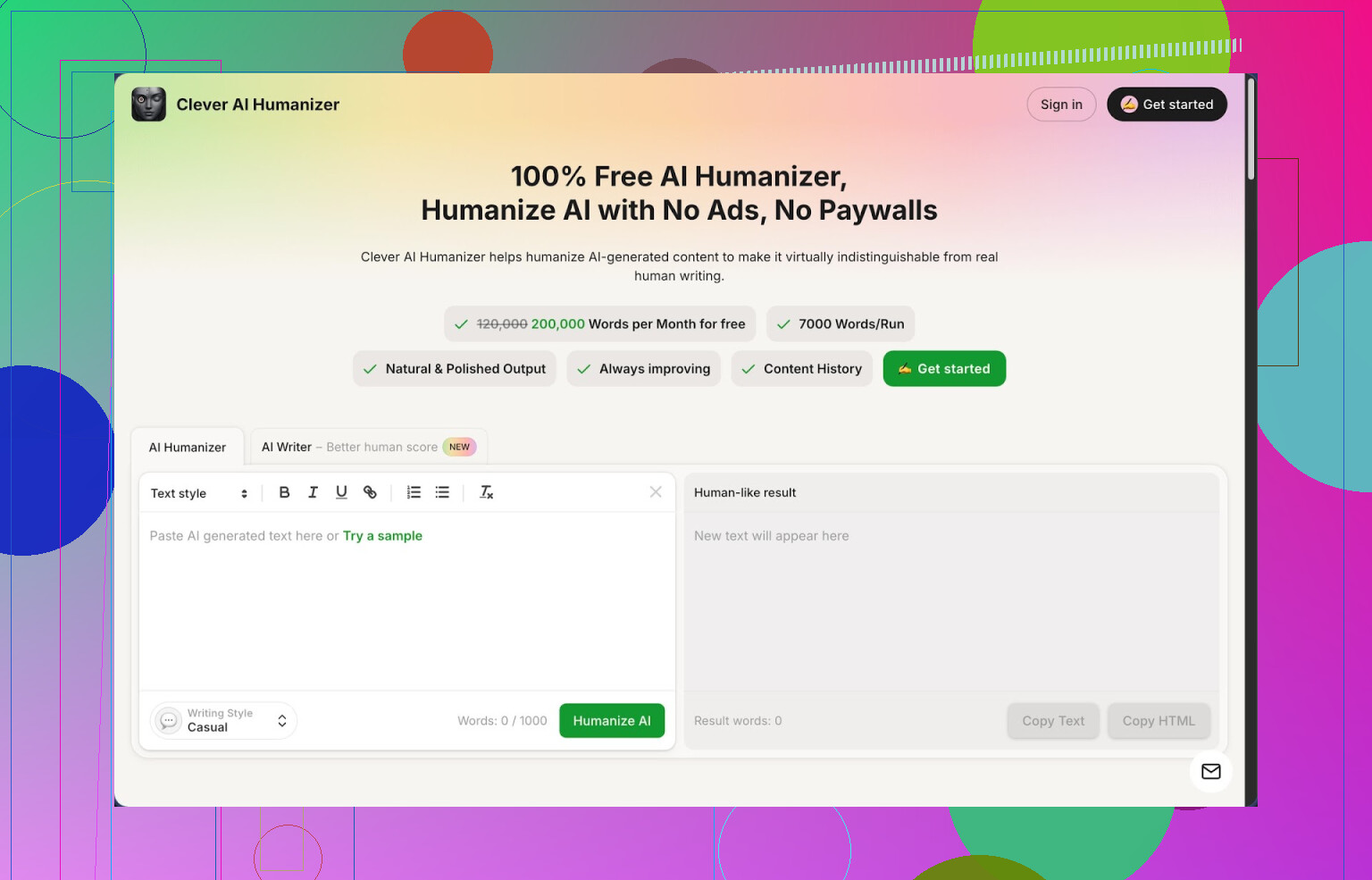
I have been messing around with Clever AI Humanizer for a while, and out of the tools I tried, it is the one I keep going back to. The main reason is simple, it is free, and the limits are not fake-free. You get about 200,000 words per month, up to 7,000 words per run, and three basic styles to work with: Casual, Simple Academic, and Simple Formal. There is also an AI writer built in, so you do not have to bounce between tabs.
I tested it on some longer chunks of AI text that were getting slammed as 100% AI on detectors. Using the Casual style, I pushed three different samples through and then ran them through ZeroGPT. All three came back with 0% AI detected. That surprised me more than anything, since most “humanizers” I tried either broke the meaning or still got flagged.
If you write with AI a lot, you know the usual pain: the text sounds flat, repeats patterns, and tools like ZeroGPT or GPTZero turn the whole thing bright red. I had a couple of client pieces thrown back for “AI style” phrasing, which is what made me look for something better in the first place. After a day of hopping between tools, Clever AI Humanizer ended up at the top of my list for 2026, mainly because it works decently and does not hide everything behind credits.
The core feature is the Free AI Humanizer. Workflow is basic, which I prefer. You paste your AI output, pick a style (I mostly use Casual), hit run, and wait a few seconds. It spits out a new version that reads more natural and less “bot voice.” It tends to remove those repetitive structures that detectors latch onto, and it usually improves readability at the same time. The bigger word limit helps if you deal with long articles or reports instead of tiny paragraphs.
What I noticed after a few runs is that it does not wreck your main points. Some tools twist sentences so much you lose your original angle. Here the structure and arguments stayed mostly intact. It changed how things were said, not what was said. For client work or essays, that matters.
Outside the humanizer, there are a few extra modules that sit in the same interface.
The Free AI Writer is for when you do not have a draft yet. You give it a topic or prompt, it generates an essay, blog post, or article, and then you can run that output through the humanizer right away. That combo gave me the best “human score” on detectors. I tried taking a long AI-written article from there, ran it through the Casual style, and saw detector scores drop from near 100% AI to low single digits or straight 0 on some checks.
The Free Grammar Checker is nothing fancy visually, but it fixed spelling slips, missing commas, and some awkward phrasing on my test pieces. It is enough to make a draft safe to send or publish without having to copy things into another grammar tool.
The Free AI Paraphraser Tool is closer to a controlled rewrite. You feed it text that you already wrote, and it gives an alternate version without changing the main meaning. I used it to rework intros for blog posts so Google would not see them as clones. It also helped when I needed a more neutral tone for reports after writing something too opinionated at first.
When you put those together, you get four things in one place: humanizer, writer, grammar fixer, and paraphraser. The flow looks like this in practice: generate or paste content, humanize it, clean up grammar, then paraphrase spots that still sound off. It saved me time because I did not need three different websites open.
If you are trying to build a simple daily workflow for essays, blog content, school work, or client drafts, this tool fits into that without much setup. No desktop app, no extensions, you just paste and go. For me, it replaced a couple of paid credits I kept burning through on other sites.
It is not perfect though. Some AI detectors still flag parts of the text in tough scenarios. For example, university-level detectors or stricter internal tools at some companies can still see patterns. Also, after humanization, the content often becomes longer. It adds extra wording and transitional phrases to break the AI-like structure. That is probably necessary to dodge detection, but if you work with hard limits on word count, you have to trim afterward.
Given that it is 100% free at the moment, I am willing to live with those trade-offs. For long writing sessions or for cleaning AI drafts that need to pass casual checks, it is the one I keep pinned in my browser.
If you want a more detailed breakdown with screenshots and AI detection proof tests, there is a longer writeup here: https://cleverhumanizer.ai/community/t/clever-ai-humanizer-review-with-ai-detection-proof/42
There is also a YouTube review here if you prefer watching someone walk through it step by step: https://www.youtube.com/watch?v=G0ivTfXt_-Y
If you want to compare experiences or see what others on Reddit think about AI humanizers in general, these threads helped me see what tools people use in different contexts:
Best AI Humanizers on Reddit: https://www.reddit.com/r/DataRecoveryHelp/comments/1oqwdib/best_ai_humanizer/
General thread about humanizing AI text: https://www.reddit.com/r/DataRecoveryHelp/comments/1l7aj60/humanize_ai/
12 Likes
I’ve tried a bunch of these too, and I agree with a lot of what @mikeappsreviewer said, but I don’t fully trust any “one click and it’s human” promise.
If your goals are:
- make text sound more natural
- reduce AI detector hits
- stay free and avoid tiny word limits
Here is what has worked for me in practice.
- Clever Ai Humanizer
Good pick if you want something close to Grammarly’s “humanize” without a paywall.
The pros you care about:
• Around 200k words per month, so you handle full articles.
• Up to 7k words per run, which helps with long essays or blog posts.
• Casual mode sounds less stiff than most tools.
I use it like this. Generate with any AI. Run once in Casual. Skim for spots that sound bloated, then trim by hand. Detectors like ZeroGPT and GPTZero often drop from 80 to under 10 on my tests, but university tools still detect patterns sometimes, so do not rely on it for academic dishonesty.
Where I slightly disagree with @mikeappsreviewer is on “set and forget”. I get decent output, but I still see filler phrases and overexplaining. If you paste straight to a client or teacher, it sometimes feels padded. Quick manual edit fixes that.
- Mix tools, do not stack humanizers
I got better scores by doing:
• Step 1: write your own short outline or bullet list.
• Step 2: generate text with AI.
• Step 3: run through Clever Ai Humanizer once.
• Step 4: manually shorten sentences and change 1 or 2 phrases per paragraph yourself.
When I ran text through multiple “humanizers”, it started to sound weird and repetitive, and detectors sometimes flagged it more, not less.
-
Keep your own voice in there
If you want “less detectable”, your own quirks help more than any tool.
Examples that helped my detector scores:
• Use a few contractions you normally use.
• Add 1 or 2 quick personal remarks per section.
• Change keyword-heavy phrases into how you would say them in a chat. -
Check readability, not only AI scores
Run your text through:
• Hemingway Editor or any free readability checker.
If readability grade is around 6 to 9 for blogs, it tends to sound more natural. Clever Ai Humanizer often bumps readability into a comfortable zone, which is a plus. -
Where Grammarly falls short for free users
You already saw it. Tight limits, constant nudging to upgrade, and weaker “tone” changes on longer texts. If you want something closer to Grammarly Premium tone tools without paying, Clever Ai Humanizer is one of the few that handles full articles without hitting a wall.
Quick starter workflow for you:
• Paste your AI text into Clever Ai Humanizer in Casual style.
• Run it once.
• Delete filler sentences.
• Swap some words for how you personally talk.
• Run a grammar check either in their grammar module or any free checker.
That hits your three needs: more natural, less robotic to detectors, and free without silly word caps.
If you’re trying to get close to Grammarly’s humanizer without paying, I’m broadly on the same page as @mikeappsreviewer and @sognonotturno about Clever Ai Humanizer being one of the few tools that isn’t trash or fake-free. But I wouldn’t treat it as some magic invisibility cloak either.
Couple of angles that haven’t really been hit yet:
-
Use humanizers as a finishing tool, not the main writer
Instead of: “AI writes everything → humanizer → done,” flip it:- Write a quick rough draft yourself (even if it’s messy bullets and ugly sentences).
- Use your LLM of choice to expand/clean it.
- Then run that through Clever Ai Humanizer once, just to smooth out the “AI cadence.”
Starting with your structure and quirks helps more with detection than stacking three different AI rewriters on top of each other. Most detectors latch onto uniform style and sentence rhythm, not just vocab.
-
Don’t always use “Casual”
Everyone keeps praising the Casual style, which is fine, but that’s exactly how stuff starts to look samey across users. If you’re doing essays, reports, or anything semi‑formal, I actually get more natural results going:- Simple Academic in Clever Ai Humanizer
- Then I manually inject a few casual bits where I would actually talk that way.
The Casual mode sometimes leans into filler (“In today’s world,” “It’s important to note that,” etc.). That’s AI-detector bait in a different outfit.
-
Change structure, not just words
A lot of “humanizers” only paraphrase. Clever Ai Humanizer is better than most, but it still mostly rewrites at sentence level. To really break the AI fingerprint:- Combine two short sentences into one, or split a long one.
- Move one sentence per paragraph to a different spot.
- Add 1 or 2 very specific details you actually know (dates, places, tiny observations).
AI detectors are starting to pick up on the bland, neatly layered paragraph structure. You can fix that in 5 minutes by shuffling things around yourself.
-
Don’t rely on passing every detector
This is where I slightly disagree with both of them. ZeroGPT and GPTZero scores are fun to look at, but they’re not the boss of reality. Some uni detectors and in‑house tools are way more aggressive and sometimes just flag “too polished” writing. Even with Clever Ai Humanizer, you’re not guaranteed anything if you’re trying to cheat on graded work. If it’s academic, better to:- Use AI to brainstorm, outline, and get unstuck.
- Then write the final version yourself, and only use something like Clever Ai Humanizer or a grammar checker as light polish.
-
Alternative free tools that pair well
Without repeating what they already said:- Use a plain paraphraser like QuillBot’s free tier sparingly on small chunks you really hate.
- Use a style checker like Hemingway or any Flesch–Kincaid tool to keep the reading level sane.
I’d avoid chaining multiple “AI humanizer” tools back to back. Every time I’ve tried that, the text started sounding like a committee of robots trying to imitate a YouTube vlog.
-
Minimal workflow that actually works
For your “less robotic, more natural, free, not microscopic limits” needs, something like this is enough:- Write bullets / messy notes yourself.
- Generate a draft with AI.
- Run through Clever Ai Humanizer (I’d try Simple Academic or Simple Formal depending on context).
- Spend 5–10 mins: delete fluff, reorder a couple of sentences, add tiny personal details.
- Quick grammar pass either with their grammar checker or any free one.
That keeps you in the “sounds like a human who used tools” zone instead of “AI pretending to be a human pretending not to be AI,” which is where a lot of people accidentally end up.
Short version: there is no free “one tap and you’re invisible” trick, but you can get close to what you want if you treat humanizers as part of a workflow instead of a magic filter.
Where I slightly disagree with @sognonotturno, @viajantedoceu and @mikeappsreviewer is on how central Clever Ai Humanizer should be. It is solid, but I’d treat it as a stylistic tool, not as the core of your process.
Clever Ai Humanizer: quick pros & cons
Pros
- Genuinely generous free tier (the word limits are actually usable for full essays or articles).
- Modes that roughly match common needs: Casual, Simple Academic, Simple Formal.
- Keeps meaning mostly intact while shifting phrasing and rhythm.
- Built in writer / grammar / paraphraser so you do not have to juggle five tabs.
- Often improves readability enough that you do not need Grammarly Premium for tone.
Cons
- Tends to inflate word count and add soft filler, especially in Casual.
- Still leaves a recognizable “processed” cadence if you rely on it too heavily.
- Harder detectors and institutional tools can still flag segments as AI influenced.
- Styles are a bit samey across long pieces, so if you never edit by hand, everything starts sounding like the same person.
Where they are right: for a free substitute for Grammarly’s humanizer tools, Clever Ai Humanizer is absolutely in the top tier just on usability and limits. Where I’d be cautious is expecting it to handle nuance like a human editor.
Instead of restating their workflows, a different angle that works well:
-
Start from your own bad draft, not from AI
Even a sloppy paragraph in your voice gives every tool something more “you shaped” to work with. Detectors dislike uniform perfection more than they dislike help with grammar. -
Use Clever Ai Humanizer only on the stiff bits
Instead of pasting an entire 3k word article, run only sections that sound obviously robotic. That reduces the “all in one voice” problem and keeps more of your natural style. -
Deliberately add imperfections afterward
Two or three short, slightly choppy sentences, a very niche detail you personally know, and 1 or 2 abrupt transitions can do more for “human feel” than another AI pass. -
Test a competitor style mix
The others talked a lot about single tool workflows. I have better luck using Clever Ai Humanizer for tone and then a basic, non humanizer grammar checker or editor for final polish. Stacking multiple “humanizers” usually backfires and creates that weird, polished-but-empty vibe.
If your priorities are: free, larger word counts, less robotic, and you are okay doing some manual cleanup, Clever Ai Humanizer is a good centerpiece. Just keep it in its lane: readability and tone smoothing, not guaranteed stealth.