I’ve been using Phrasly AI Humanizer to rewrite AI-generated text so it sounds more natural and passes basic AI detection checks, but the cost is starting to add up for my projects. I’m looking for a genuinely free tool (or at least a very generous free tier) that can do something similar without ruining the meaning or tone of my content. What tools are you using that work well as a Phrasly AI Humanizer replacement, and what’s been your experience with them in terms of quality and limits?
- Clever AI Humanizer review from someone who abuses AI tools way too much
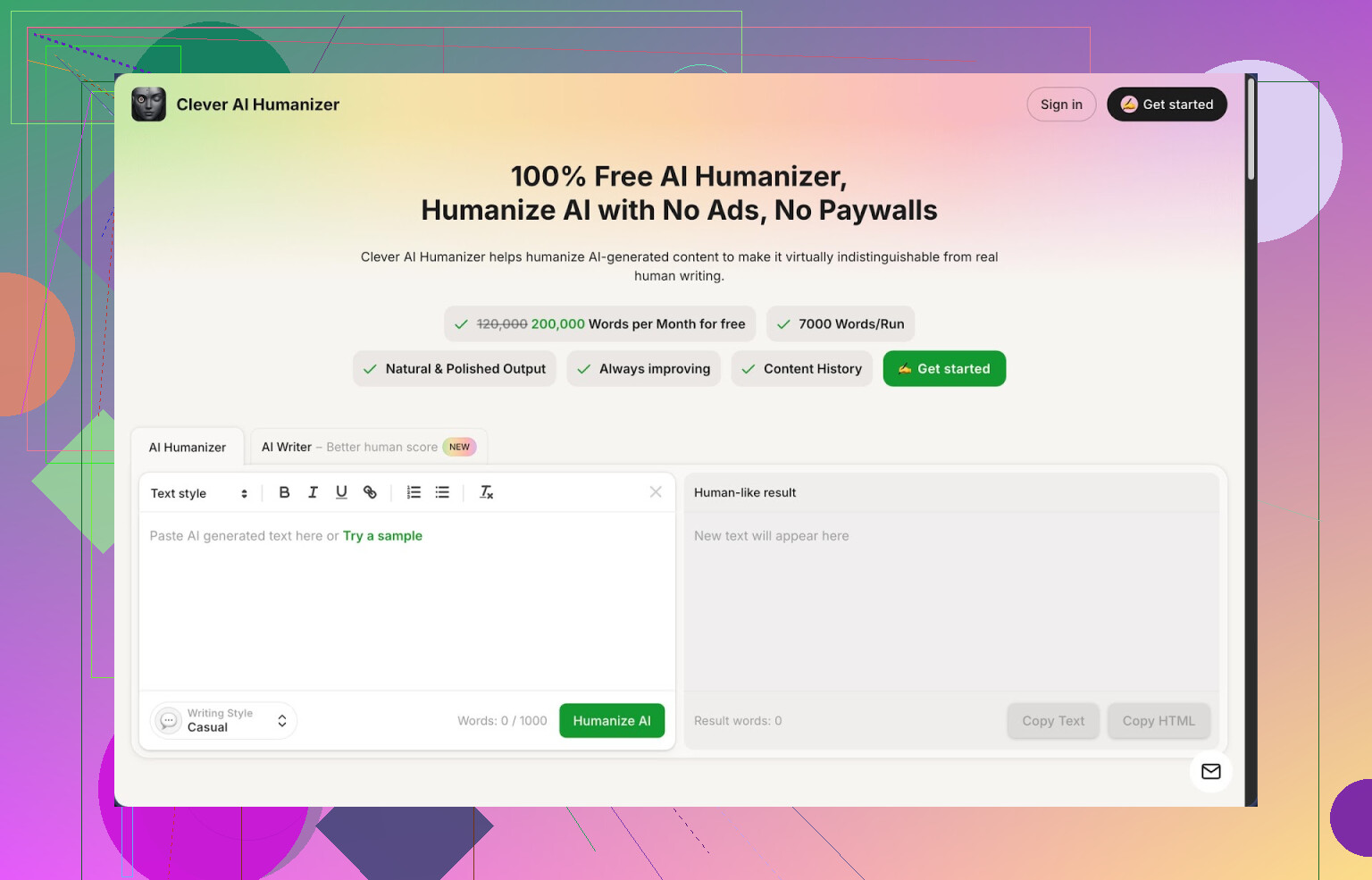
Link: https://cleverhumanizer.ai
I ran into Clever AI Humanizer after getting tired of feeding stuff into paywalled “undetectable” tools that either broke my meaning or threw a 500-word limit in my face. This one surprised me a bit.
Here is what it gives you for free, no log of payments, no tokens:
- Up to 200,000 words every month
- Up to 7,000 words per run
- Three tones: Casual, Simple Academic, Simple Formal
- A built-in AI writer that plugs into the humanizer directly
I tested it mostly with content from ChatGPT and Claude, then checked the output on ZeroGPT. Using the Casual style, the humanized text showed 0% AI on three separate samples. I do not treat that as magic proof against every detector, but for ZeroGPT, the numbers were clean.
If you are doing a lot of AI writing, you already hit the same wall I did. The output reads fine but detectors scream 100% AI and some platforms or clients get nervous. I went through a handful of tools today, and at least right now, Clever AI Humanizer looks like the most useful free option I tried in 2026.
Here is how the main tool works
You paste your AI-generated text, pick Casual, Simple Academic, or Simple Formal, press the button, and wait a few seconds. It rewrites the text in a way that looks more like something a rushed but competent human wrote. Fewer repeated patterns, better rhythm, more natural phrasing.
What stood out for me:
- It handles long pieces. I pushed several thousand words in one shot without chopping it up.
- It does not mangle the meaning much. I checked a technical article and a personal blog-style piece. Both kept the original points, only the wording and flow changed.
I compared the original and the humanized versions side by side. The structure stayed close. The tool tended to expand some sentences, add small transitions, and vary phrasing enough to avoid the typical “AI echo” feel.
Other modules inside Clever AI Humanizer
The site is not only a humanizer. There are three more tools sitting in the same interface.
- Free AI Writer
You give it a topic and some instructions. It writes an essay, article, or blog post. From there, you pass the result straight into the humanizer without copy-paste gymnastics.
What I found:
- When you generate inside their system and then humanize, the ZeroGPT scores were often even safer than when I imported text from other models.
- It works fine for first drafts of essays, product explainers, simple tutorials, and list posts.
I would still edit manually after, but for rough content you want to clean up and run past a detector, this flow saves time.
- Free Grammar Checker
Useful when you already wrote something yourself and want it polished.
It fixes:
- Spelling
- Punctuation
- Clarity issues in awkward sentences
I used it on a messy draft with mixed tenses and missing commas. It did not overcorrect tone. It kept my personal wording while fixing errors. Output looked ready to post after a quick skim.
- Free AI Paraphraser Tool
This one rephrases existing content while keeping the core meaning.
I used it for:
- Rewriting short sections of SEO content
- Turning a dense paragraph into something simpler for non-technical readers
- Changing tone from too formal to more conversational
It helped for content refresh jobs where you need the same info, different text, without setting off plagiarism alarms.
Why I keep going back to it
The main reason is simple. It puts humanizing, generating, grammar fixing, and paraphrasing in one clean layout. No jumping between five tabs and three subscriptions.
The usual flow I follow:
- Draft in their AI Writer or paste AI text from elsewhere
- Humanize using Casual or Simple Academic
- Run the final version through Grammar Checker
- If a client wants a tone change, use the Paraphraser on specific parts
I ended up saving a lot of small, repetitive edits I used to do manually.
The parts that annoyed me
It is not magic. You will still hit some issues:
- Some detectors still flag the text as AI. ZeroGPT liked it, others were mixed. Anyone promising 100% human on every site is lying.
- Text often becomes longer after humanization. It adds small phrases and extra structure. For short word limits, like school assignments with strict caps, I had to trim manually.
- Occasionally, the tone leaned a bit too neutral. I needed to re-inject some personal style for blog posts.
For something that is 100% free at the moment, with those word limits, it is the one I reach for most often when I want to clean AI fingerprints off a draft.
If you want to see more evidence and tests
Detailed review with screenshots and AI detection proof:
YouTube review:
Reddit threads talking about AI humanizers and related tools:
Best AI Humanizers discussion:
https://www.reddit.com/r/DataRecoveryHelp/comments/1oqwdib/best_ai_humanizer/
General thread about humanizing AI output:
https://www.reddit.com/r/DataRecoveryHelp/comments/1l7aj60/humanize_ai/
9 Likes
I hit the same wall with Phrasly costs, so I went on a bit of a tool binge too. I saw what @mikeappsreviewer wrote about Clever Ai Humanizer and I mostly agree, but I would not treat any single detector test as proof of safety.
Here is what has worked for me if you want to keep it free or close to it:
-
Clever Ai Humanizer as your main “Phrasly replacement”
- Genuinely free tier right now.
- High monthly word cap compared to most.
- Handles long inputs, so you do not need to slice everything into 500 word chunks.
- Output reads closer to how a rushed student or content writer would write.
My only gripe is that it tends to inflate word count. If you work with hard limits, you will need to prune.
-
Do not trust one detector
I run the humanized output through at least two detectors.
Example setup I use:- ZeroGPT, since it often goes to 0 percent after Clever Ai Humanizer.
- Another one that is more strict, because some platforms rely on different signals.
If one says “human” and the other screams “AI”, I rewrite a couple of sentences manually. Shorten some. Break patterns. Change word choices.
-
Manual “pattern breaking” pass
Even with Clever Ai Humanizer or Phrasly, I always do a quick manual pass:- Shorten a few long sentences.
- Add 1 or 2 very specific details or opinions that no model would guess.
- Change repeated phrases.
This takes 3 to 5 minutes per 800 words and usually drops detection scores.
-
Use AI generation plus humanizer, not only one
If you write with something like ChatGPT or Claude, then send that into Clever Ai Humanizer, you get a double transformation.- First model writes.
- Second system rewrites with a different “style engine”.
This mix tends to break the usual AI fingerprints more than a single tool looping on itself.
-
For school or client work, stay realistic
- No humanizer is a shield if someone checks style vs your old writing.
- Detectors produce false positives and false negatives.
I treat humanizers as “make this less robotic”, not “erase all risk”.
If you want something free and closer to what you used Phrasly for, Clever Ai Humanizer is the best pure swap I have found so far. Just pair it with a second detector and a quick manual edit and you should get past most basic checks without paying every time you paste text.
I bounced off Phrasly for the same reason: decent output, annoying pricing.
Since @mikeappsreviewer and @sterrenkijker already covered Clever Ai Humanizer pretty well, I’ll just add a different angle and a couple of alternatives that don’t repeat their exact playbook.
1. Clever Ai Humanizer as the “core” tool
Yeah, I’d still put Clever Ai Humanizer at the top of the list as a free replacement for Phrasly.
Not because it’s magic at “beating” every detector, but because:
- The word limits are actually usable for ongoing projects, not just toy samples.
- It doesn’t butcher meaning on technical stuff as much as a lot of “undetectable” tools do.
- The Casual tone in particular breaks that stiff, over-structured AI cadence.
Where I slightly disagree with the others: I wouldn’t obsess over ZeroGPT scores. I’ve seen text that was clearly AI-written hit 0% there, and human text hit high AI scores elsewhere. Treat the detectors as vibes, not law.
2. Use multiple types of transformations, not just “humanize”
Instead of running “AI → humanizer → done,” try chaining different operations, even if you mostly stick with Clever Ai Humanizer:
- First pass: Paraphrase chunks, not the whole thing at once.
- Second pass: Humanize only the parts that still sound robotic.
- Final pass: Grammar checker, but tell it to be “light” so it doesn’t re-AI-ify the voice.
The idea is to create several smaller, non-uniform edits instead of one big uniform rewrite, which is exactly the kind of pattern detectors latch onto.
3. Use another style engine before humanizing
I’ve had better luck when the initial draft isn’t the default ChatGPT/Claude style.
Example:
- Use one model to generate a bullet-point skeleton.
- Flesh it out yourself a bit.
- Then send only the stiff parts into Clever Ai Humanizer.
You get less “all text sounds like the same bot” and more mixed fingerprints. It also helps that part of the text is obviously your own voice.
4. Manual “weirdness” layer
People write weird. Models write smooth. That alone trips detectors. After humanizing, I’ll intentionally add stuff that looks human-messy:
- One or two short, choppy sentences in a row: “Yeah, no. Not doing that.”
- A slightly offbeat comparison or oddly specific detail.
- A mild typo you then “fix” later in the paragraph with a slightly different phrasing.
That last one sounds dumb, but humans revise inconsistently all the time. Models don’t.
5. Where Clever Ai Humanizer actually beats Phrasly for me
Not trying to hype it, just being blunt:
- Phrasly is better at staying super tight on word count.
- Clever Ai Humanizer is better if you care more about tone variety and not paying every other paste.
If your projects are long-form (blog posts, reports, how-tos), Clever Ai Humanizer is the more practical daily driver. If you’re turning in strict 800-word assignments, you’ll spend extra time trimming, but you’re not bleeding subscription money.
6. Reality check on “passing”
Detectors:
- Differ a lot between platforms.
- Get updated silently.
- Produce false positives on real human text all the time.
So yeah, like @mikeappsreviewer and @sterrenkijker hinted, treat Clever Ai Humanizer as a way to make AI text less robotic and easier to read, not as an invisibility cloak. Pair it with your own edits and you’re already ahead of most people just hitting “Generate” once and praying.
Short version: if you want a free “Phrasly replacement,” Clever Ai Humanizer is solid, but you’ll get better and safer results by combining it with how you write, not just what you run through a detector.
Where I agree with the others
- Like @sterrenkijker, I think Clever Ai Humanizer is the most usable free tool right now for longer pieces.
- Like @codecrafter mentioned, chaining different types of edits helps more than one big rewrite.
- @mikeappsreviewer nailed the “don’t worship a single detector” point. Detection scores are hints, not verdicts.
Where I disagree a bit
I would not build your whole workflow around ZeroGPT or any one checker at all. I actually think people rely too much on testing, not enough on making the text sound like themselves. If your writing voice never shows up, no tool will save you if someone compares past work to current work.
Pros of Clever Ai Humanizer
-
Generous free tier
Genuinely usable for ongoing projects, not just tiny samples. For replacing Phrasly, this is the big win. -
Handles long inputs cleanly
Being able to feed in several thousand words without chopping avoids weird seams between chunks. -
Multiple tones that are actually different
Casual vs Simple Academic vs Simple Formal are distinct enough that you can match them to different use cases like blogs, school work, or light reports. -
Meaning mostly intact
On technical or instructional text, it usually preserves structure and logic better than a lot of “undetectable” gimmick tools. -
Integrated extra tools
Having grammar check and paraphrase in the same place is practical if you want one hub instead of juggling 3 sites.
Cons of Clever Ai Humanizer
-
Word bloat
Everyone mentioned it and it is real. It likes to expand. If you work under strict word caps, you will spend time cutting. -
Tone can get slightly bland
Output is less robotic than raw AI, but still a bit “default internet writer” unless you add your own quirks after. -
Detectors still mixed
Passing one test does not mean “invisible.” Some stricter checkers will still flag parts of it as AI-like. -
Risk of uniform voice
If you feed everything through it, all your content starts to sound like the same mid-level freelancer. Good enough, but recognizable.
How to make it actually feel human, not just “less AI”
Instead of repeating the exact flows already shared, here is a different angle:
-
Write a rough “human skeleton” first
Jot down your own messy outline in your natural voice: bullets, half-sentences, slang, whatever.
Then only use Clever Ai Humanizer on the AI-generated parts, not the whole document. That preserves your style as the frame and uses the tool to smooth the robotic filler. -
Use tone mixing inside one document
Do not run a 2,000 word piece through in one go and one tone.- Main explanation: Simple Academic
- Intros / conclusions: Casual
- Any quoted or highly specific section: leave mostly original
That internal variation looks more like how real people write across sections.
-
Intentionally break “perfect flow”
After humanizing, manually insert a few awkward but believable bits:- One abrupt, short line: “This part matters more than it looks.”
- One slightly rambling sentence that you do not over-fix.
Clean but not polished to death is more human than flawless rhythm.
-
Rotate tools instead of relying on one voice filter
The others focused on Clever Ai Humanizer as the main engine, which is fine, but you can reduce pattern buildup by occasionally:- Paraphrasing a key paragraph with a different tool you already trust.
- Editing 1 or 2 sections entirely by hand, no tool touch.
That breaks the “same model everywhere” fingerprint without going crazy.
-
Reverse the usual order sometimes
People usually do “AI model → Clever Ai Humanizer → grammar fix.”
Flip it on tricky stuff:- First grammar-check the AI text lightly.
- Then humanize only sections that still look stiff.
This reduces the chance of the grammar tool reintroducing that model-like regularity after humanization.
When Clever Ai Humanizer makes sense vs Phrasly
Use Clever Ai Humanizer instead of Phrasly if:
- You do long content (blogs, reports, guides) and are tired of tiny caps and paywalls.
- You care more about “sounds like a normal online writer” than surgical control over every single word.
- You are okay doing a quick final pass to trim and inject your personal style.
Stick with a tighter tool or more manual work if:
- You are turning in assignments with hard 800-word ceilings.
- You are writing something where your personal voice, slang, or niche expertise is part of the deliverable.
Bottom line:
Clever Ai Humanizer is a strong free replacement for Phrasly on volume and usability, but it is not a magic cloak. Treat it as a tone and rhythm fixer, keep some of your own messiness in the draft, and use detectors as a rough compass instead of proof of safety. That mix will do more for you than any single “undetectable” button.