I’ve been using GPTHuman AI but I’ve run into some limitations and costs that don’t work for my current budget and workflow. I’m looking for genuinely free or low-cost competitors that offer similar AI capabilities, good quality responses, and reasonable usage limits. What tools or platforms would you recommend, and what has your experience been with them in real-world use cases like writing, coding, or research
- Clever AI Humanizer Review
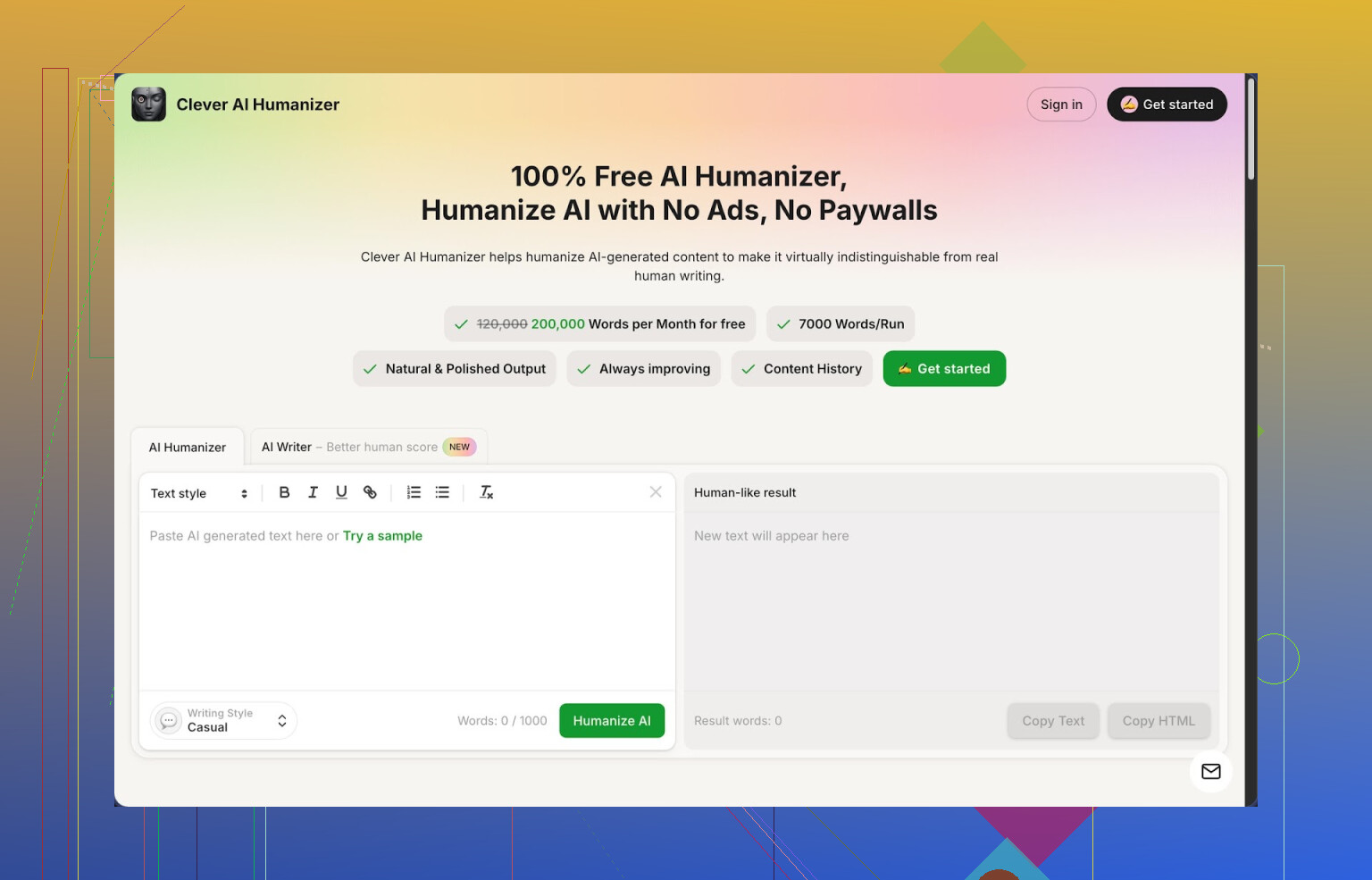
I tripped over Clever AI Humanizer here:
I was looking for something free that did not lock me into tiny word limits. This one gives 200,000 words per month, with runs up to 7,000 words. No card, no “trial”, nothing like that when I used it. Three styles show up in the dropdown: Casual, Simple Academic, Simple Formal. There is also an AI writer built in, so you do not have to jump between tabs.
I threw three different AI‑written samples at it, all in the Casual style, then checked with ZeroGPT. Each one came back as 0 percent AI on ZeroGPT on my side. That surprised me a bit, because most tools I tried still trip some detector somewhere. This one, at least for those tests, slipped under. Your mileage will differ, but that is the data point I got.
What I usually run into with AI text is this:
• It sounds flat and repetitive.
• Detectors scream 100 percent AI.
Clever AI Humanizer tries to fix both in one step.
How I used the main “Free AI Humanizer”
I pasted a full article from another model, picked “Casual”, hit the button, waited a few seconds. It spat out a longer version of the same piece, same structure, but with more variation in sentence length and some extra connective phrases.
Couple of notes from testing:
• It keeps the main meaning. I checked by comparing each paragraph line by line in another window.
• The tone shifts a bit. Casual feels like a Reddit post, Simple Academic feels like a stripped‑down essay, Simple Formal sounds like a cleaned‑up company email.
• Long inputs do not choke it. I pushed near 7,000 words and it still processed.
If you write essays, blog posts, product explainers, or homework with AI and do not want to babysit every sentence, this is decent. You paste once, adjust style, done.
Other tools inside Clever AI Humanizer
Everything sits on one site, no extra logins for each feature. Here is what I tried and what I saw.
- Free AI Writer
This is the part where you tell it what you want, and it generates text for you. After that, you send it straight into the humanizer with one click.
Use case example from my test:
• Prompt: a 1,200‑word article about local SEO basics for small shops.
• It generated a first draft in a few seconds.
• I hit the humanize option in Casual.
Result:
• ZeroGPT showed 0 percent AI on that output too.
• The draft got longer, from ~1,200 words to ~1,550 words.
• Structure stayed similar, but the text had more filler transitions and variations that usually trick detectors.
If you want a “one pipeline” setup, this is faster than writing in ChatGPT, copying, then finding a separate humanizer.
- Free Grammar Checker
I tossed in a draft with wrong commas, missing articles, and a few broken sentences. It:
• Fixed spelling.
• Smoothed punctuation.
• Clarified a couple of awkward fragments without rewriting entire paragraphs.
So, it feels closer to Grammarly’s core function, but without style scores or tone wheels. If you only care about “will this embarrass me in public”, it does enough.
- Free AI Paraphraser Tool
This one rewrites text you already have. Not full “humanization”, more like rephrasing while sticking to the same idea. I used it for:
• Rewriting a section of a blog post so it would not look like a copy of another site I own.
• Adjusting tone from formal to something closer to how I talk.
It preserved structure and meaning, but changed word order and phrasing. For SEO or reusing your own content, it feels useful. I would not use it to rewrite copyrighted stuff from other people though, that is asking for trouble.
How it fits into a daily workflow
After a day of testing, this is the flow that made sense:
- Draft with AI Writer or your usual model.
- Run the text through the Humanizer in Casual or Simple Academic.
- Pass the result through the Grammar Checker.
- If a section sounds off, send only that part to the Paraphraser.
Everything happens in one interface, so you do not juggle multiple tools or subscriptions. If you publish a lot of content or do homework that needs to look “less AI”, this saves time.
Stuff I did not like
It is not magic. Some points that annoyed me a bit:
• Certain detectors will still flag parts of the text. ZeroGPT showed 0 percent AI on my tests, but other tools like GPTZero or Originality.ai might not agree. Plan for mixed results across platforms.
• Output often gets longer. To break AI‑style patterns, it adds more words. If you work with strict limits, like assignments with a hard cap or tweet‑length posts, you will need to trim.
• Occasionally it overexplains obvious points. You might want to delete bloat after humanization.
Is it worth using
If you want a free tool that:
• Does not nag you with paywalls mid‑run.
• Handles long texts up to 7,000 words each.
• Packs humanizing, writing, grammar checks, and paraphrasing in one place.
Then it is worth a try. I ended up keeping it in my regular stack for blog posts and client drafts.
If you want deeper info and screenshots, the detailed review here helped me cross‑check my own results:
Video review is here if you prefer watching:
There is also some discussion about AI humanizers and detector experiences here:
Best AI humanizers thread:
https://www.reddit.com/r/DataRecoveryHelp/comments/1oqwdib/best_ai_humanizer/
General humanizing AI talk:
https://www.reddit.com/r/DataRecoveryHelp/comments/1l7aj60/humanize_ai/
13 Likes
I hit the same wall with GPTHuman AI, so here is what I swapped to and how it fits a low or zero budget setup.
I agree with @mikeappsreviewer on Clever Ai Humanizer being solid. The big win for you is the 200k words per month and no card. For long essays, blog content, or client drafts, it takes the cost pressure off. Where I see it differ from GPTHuman AI is volume and the fact you get the writer, humanizer, grammar, and paraphraser in one place. If you want a single browser tab workflow, it fits.
That said, I would not rely only on detector scores like ZeroGPT. Detectors disagree a lot, and they flag human text too. I treat Clever Ai Humanizer as a style and clarity tool first, then I do a quick personal edit pass for key parts. That gives you safer output than chasing 0 percent AI badges.
For a full setup that stays cheap:
- Drafting and general chat
Use:
• ChatGPT free (GPT 3.5) for fast drafting and brainstorming.
• Gemini free for rewrites and outlines when GPT’s rate limits hit.
Both give you unlimited or high volume text for zero dollars if you do not need heavy files or long chats.
-
Humanizing and paraphrasing
• Clever Ai Humanizer for long content and one click humanize.
Use it on final drafts, not early rough ideas, so you do not double process.
• QuillBot free tier for small chunks when you want tighter paraphrases. It caps characters, so I use it on intros, conclusions, and headings. -
Grammar and clean up
• Clever Ai Humanizer’s grammar checker for quick passes.
• LanguageTool free browser extension to catch typos live in Google Docs or WordPress. Good for the stuff you forget, like commas and duplicated words. -
Cost control tips
• Keep prompts short and clear. You spend less time regenerating.
• Batch tasks. Draft one long article in ChatGPT, then send sections into Clever Ai Humanizer instead of separate full runs.
• Save reusable prompts in a doc, such as “rewrite in plain English, 8th grade level, neutral tone” so you reduce trial and error.
Where I disagree a bit with the “set and forget” approach. If you try to automate every sentence, your writing starts to sound the same. I leave core parts, like stories or opinions, more “mine” and use Clever Ai Humanizer on the exposition, guides, and list sections.
If your goal is “similar capabilities to GPTHuman AI” with low cost, a realistic stack is:
• ChatGPT free for ideas and raw content
• Clever Ai Humanizer as your main GPTHuman AI alternative
• One extra free paraphraser or grammar tool as backup
You keep your spend at zero or near zero and still get decent quality for blogs, school, or light client work.
You’re not the only one bouncing off GPTHuman’s limits. Since @mikeappsreviewer and @sonhadordobosque already covered Clever Ai Humanizer really well, I’ll just add alternatives and a slightly different angle.
If your main goal is “GPTHuman-style output, low or zero cost,” here’s what’s actually been usable for me:
-
Clever Ai Humanizer as your main swap
I do agree with them on this: as a GPTHuman AI competitor, Clever Ai Humanizer is the closest in “paste → humanize → done” workflow. The 200k words cap is generous for a free tool, and the fact it has built‑in writer + humanizer + paraphraser means you are not juggling 4 tabs.
Where I disagree a bit with both of them: I would not trust any detector numbers as a success metric. I treat Clever Ai Humanizer more like “style randomizer + flow improver.” It is good at that, and the pricing is friendly to a broke workflow. -
For straight writing instead of ‘humanizing’
If you don’t need a special “humanizer” step and just want text that sounds less robotic from the start:
- ChatGPT free: Use it with more specific tone prompts:
“Write in loose, conversational English, vary sentence length, add a couple of concrete examples, avoid cliché phrases.”
Half the humanizing problem disappears if the initial draft isn’t stiff. - Gemini free: Similar idea. I sometimes like its phrasing more for casual stuff.
This is where I differ from the “pipeline everything through a humanizer” approach. If the base draft is decent, you can often skip the dedicated humanizer and just do a light manual edit.
- Other cheap / free “humanizer‑ish” tools
They’re not as all‑in‑one as Clever Ai Humanizer or GPTHuman, but for tight budgets:
- QuillBot free
Good for short chunks, especially intros and conclusions. I use it when Clever’s style is a bit too wordy. The caps are annoying, though. - LanguageTool + manual passes
Not a humanizer, but cleaning grammar and structure plus a quick personal rewrite of repeated phrases often beats pushing everything through multiple AI filters.
- How to keep it from turning into AI soup
One problem with chaining GPTHuman → other model → humanizer: everything starts sounding like the same bland smoothie. To avoid that:
- Use AI for the boring parts: definitions, step lists, transitions.
- Write your own hooks, anecdotes, and opinions.
- If you use Clever Ai Humanizer, feed it sections, not entire 3k‑word monsters every time. Switch styles between “Casual” and “Simple Academic” from section to section if it starts feeling samey.
- When GPTHuman is still worth opening
Even though you’re trying to move away from it, one honest note: if GPTHuman has a specific tone or feature you like, you can:
- Use it only for key pieces
- Then run the result through Clever Ai Humanizer for final polish
That way you’re not paying or hitting limits for every paragraph.
So, short version:
- Use Clever Ai Humanizer as your main GPTHuman AI free competitor.
- Draft in ChatGPT / Gemini to avoid doing double work.
- Use QuillBot / LanguageTool as light helpers instead of building some 5‑step AI pipeline.
You’ll spend more time trimming fluff than fighting paywalls, which is a better problem to have tbh.
Short version: you can ditch GPTHuman AI without wrecking your workflow, but you probably want a mix of tools, not a 1:1 clone.
1. Where I slightly disagree with others
@sonhadordobosque, @chasseurdetoiles and @mikeappsreviewer are all leaning pretty heavily on detection scores as proof that Clever Ai Humanizer “works.” I would not anchor your choices on detector percentages. Detectors are noisy, models keep changing, and what passes one check today can fail another tomorrow.
I’d optimize for:
- Cost
- Speed
- How “natural” it reads to an actual human, not a meter
Clever Ai Humanizer helps with that, but it is a tool in the stack, not a magic shield.
2. Clever Ai Humanizer as a GPTHuman AI alternative
If you liked GPTHuman’s “paste → humanize → copy out” simplicity, Clever Ai Humanizer is probably the closest mental match.
Pros of Clever Ai Humanizer
- Very generous free quota for most solo workflows
- Handles long pieces in one go, so less chopping text into tiny chunks
- Built in writer + humanizer + paraphraser + grammar checker, so fewer tabs and logins
- Style toggles like Casual / Simple Academic / Simple Formal make it easy to quickly shift tone
- Decent for client drafts, essays, blogs where you want less “obvious AI” rhythm
Cons of Clever Ai Humanizer
- It tends to inflate word count, which is annoying for tight limits
- Can overexplain and add fluff, so you still need a pruning pass
- Output can start to sound samey if you pump everything through it on the same style
- AI detectors are inconsistent across sites, so you cannot rely on a single “0 percent AI” reading
- Limited fine control: good for quick passes, less ideal if you want precise, line level edits
I would treat it as a “bulk smoother” rather than a precision editor.
3. Alternatives that complement it (instead of repeating the same stack)
Since the others already talked through the classic combo of ChatGPT + Gemini + QuillBot, here are angles that fill different gaps:
a) For structure and logic, not just wording
If GPTHuman AI was your “make this sound better” button, you might be skipping a more important step: structure.
Try this pattern:
- Use any free chat model to outline: headings, subheadings, bullet points.
- Write or co write short paragraphs under each heading.
- Only then run sections through Clever Ai Humanizer for flow and style.
You get:
- Better logical order
- Less need to “fix” awkward passages with endless re paraphrasing
b) For keeping your voice
One thing none of these tools do by default: protect your personal style.
A simple way around that:
- Write a short “voice sample” yourself (300 to 500 words of you talking about anything).
- Tell your drafting model: “Match the style of this sample: [paste sample].”
- After drafting, use Clever Ai Humanizer only on the driest, most generic parts, not your anecdotes or opinions.
That keeps your content from turning into bland AI soup.
4. Practical workflow that avoids overlap with what was already said
Here is a slightly different, budget friendly setup that does not just repeat the same steps:
-
Planning pass
Use any free chat model purely for:- Title ideas
- Outline
- Bullet list of key points
-
Human first draft
You free type the first 20 to 30 percent of the piece. This locks in your voice and angle. -
Guided fill in
Ask an AI to fill gaps only inside your sections, not to rewrite everything. For example:
“Add two more sentences that explain this benefit in simple language and one concrete example.” -
Clever Ai Humanizer pass
Feed it only:- Explanatory sections
- How to steps
- Definitions
Skip hooks, stories, controversial takes. That is where you want your own phrasing.
-
Final manual tighten
Read out loud once. Anywhere you trip or get bored, cut or re phrase by hand.
This one step is where you beat both GPTHuman AI and any competitor in “human feel.”
5. When to actually not use a humanizer
This is the part that often gets ignored:
You do not always need Clever Ai Humanizer, GPTHuman AI, or any “humanizer” if:
- You are writing very short content (emails, short answers, social replies)
- You already used a good “conversational tone, vary sentence length” prompt
- You are willing to spend 3 to 5 minutes editing yourself
In those cases, throwing another AI filter on top can:
- Add unnecessary fluff
- Water down your voice
- Introduce small factual distortions
So I would reserve Clever Ai Humanizer for:
- Long form text where the “AI rhythm” is really obvious
- Bulk client content
- Reusing or repurposing your own old posts so they do not read like copy paste jobs
6. How it compares in practice to GPTHuman AI
Different feel, roughly similar purpose.
- GPTHuman AI: feels a bit more “one trick,” focused on humanization as a product.
- Clever Ai Humanizer: more modular. Writer, humanizer, paraphraser, grammar all rolled together.
If you liked GPTHuman AI’s simplicity, you should be comfortable with Clever Ai Humanizer in a day.
If you care about nuance, you will still need to:
- Control what sections you send in
- Edit after the fact instead of trusting a single click
If you keep your stack lean (one free chat model + Clever Ai Humanizer + maybe a browser grammar checker), you can get very close to your old GPTHuman workflow with almost no spend and less time wrestling with caps and paywalls.