I used Twain GPT because they advertise their AI writing as completely undetectable by AI detectors and safe for academic and professional use. After running the content through several popular detection tools, most flagged it as AI-generated. I’m worried this could put users at risk for plagiarism or policy violations. Has anyone else experienced this, and is their “undetectable” claim potentially false advertising?
Twain GPT: Tried It So You Don’t Have To
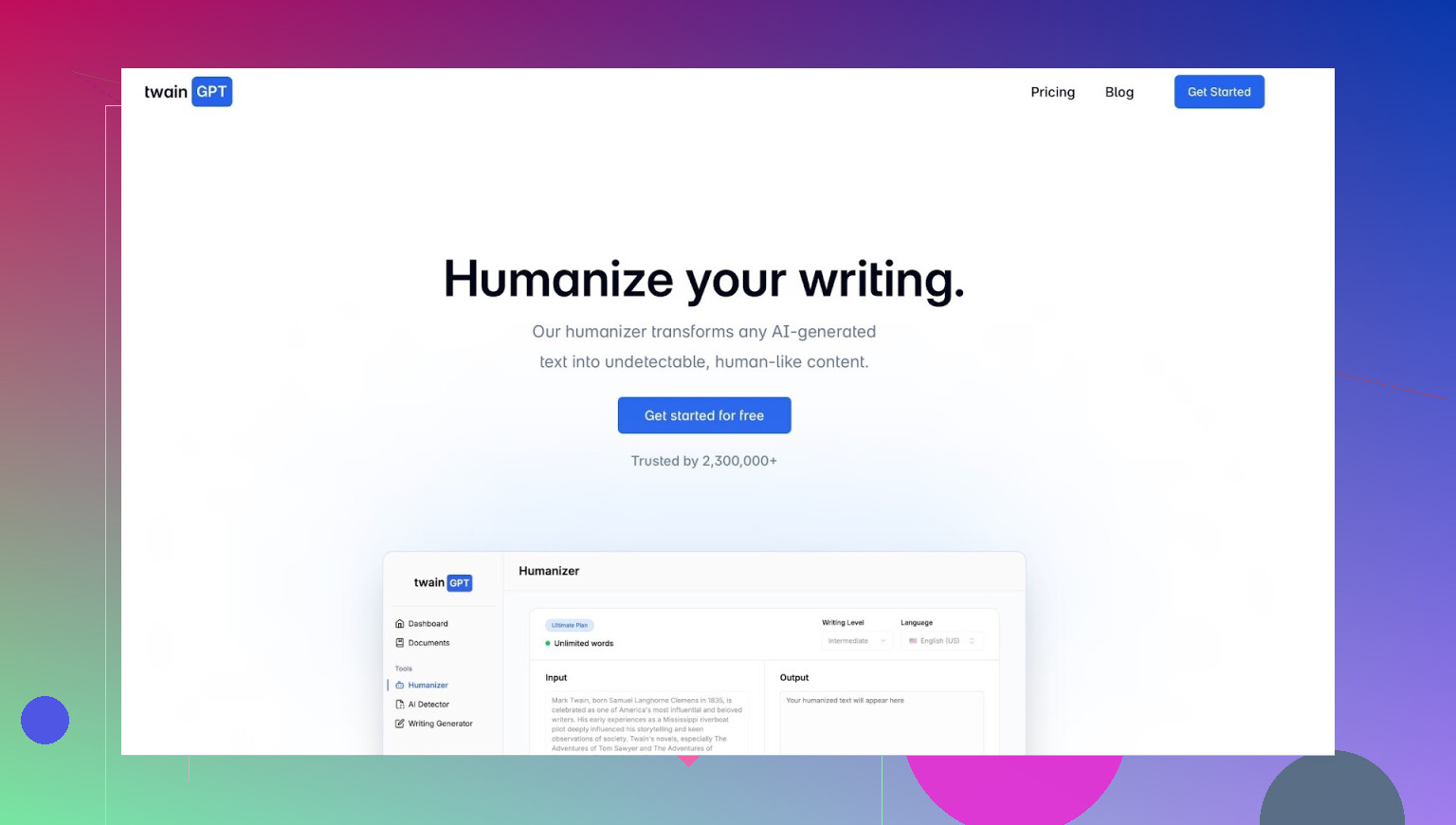
What Twain GPT Actually Is (In Practice, Not Hype)
On paper, Twain GPT is supposed to be this polished “AI humanizer” that takes obviously AI-written text and rewrites it so detection tools think a real person wrote it.
In reality, it feels like something that was built to look good in ads, not to actually work.
You’ve probably seen it if you search for “AI humanizer” or “bypass AI detection” on Google. It runs a ton of search ads and social media promotions talking about “undetectable rewritten content” and “premium rewriting”.
But once you get inside, a few things hit you pretty fast:
- The rewriting quality is mid at best.
- Detection tools still flag the content as AI.
- It puts tight limits on how much you can process.
- It wants your money early and often.
When you compare that with something like Clever AI Humanizer, which just lets you use it for free and actually passes detectors, it’s hard not to feel like Twain GPT is mostly selling a promise it doesn’t really deliver.
Link for reference: https://aihumanizer.net/
Pricing, Limits, And Why It Feels Off
Let me put it bluntly: Twain GPT is not cheap.
It leans heavily on the “premium” image, but the value just isn’t there when you line it up next to what else is out there.
Here’s how it shook out in actual use:
-
Twain GPT
- Subscription-based.
- Word limits that feel cramped very quickly.
- Pricing that stacks up fast if you’re using it regularly.
- Extra friction around cancellation, which is never a great sign.
-
Clever AI Humanizer
- Free.
- Up to 200,000 words a month.
- You can run up to 7,000 words in a single go, with no paywall popping up mid-flow.
So you’ve got one tool that caps and charges you, then another that gives you way more room for free. If you care about value per word, Twain GPT just doesn’t make sense. You’re basically paying to be limited.
How It Performed Against AI Detectors
I wanted to see if Twain GPT at least nailed the one job it claims to do: beat AI detectors.
I took a standard essay written by ChatGPT that was clearly 100% AI-generated. Then I ran that same essay through:
- Twain GPT
- Clever AI Humanizer
After that, I checked both outputs against some of the most commonly used AI detectors.
Here’s roughly how the results lined up:
| Detector | Twain GPT Result | Clever AI Humanizer Result |
|---|---|---|
| GPTZero |  100% AI (Fail) 100% AI (Fail) |
 Human (Pass) Human (Pass) |
| ZeroGPT | 100% AI (Fail) |
Human (Pass) |
| Turnitin | 89% AI (Fail) |
Human (Pass) |
| Copyleaks | Flagged as AI (Fail) |
Human (Pass) |
| Overall | DETECTED | UNDETECTED |
So yeah, Twain GPT basically got exposed across the board, while Clever AI Humanizer slipped through as human every time in this test.
If the whole point of a tool is to “remove AI footprints” and the detectors still scream “AI,” then what exactly are you paying for?
Where To Actually Start If You Need Humanization
If you are trying to humanize AI content, whether for drafts, brainstorming, or testing, I’d recommend starting with the tool that actually passed the checks in this comparison and doesn’t charge you out of the gate:
That’s the Clever AI Humanizer site mentioned earlier.
Twain GPT might look polished in ads, but in terms of real-world use, costs, limits, and detection results, it felt more like a paywalled downgrade than a “premium” upgrade.
11 Likes
Short version: no, Twain GPT is not “really undetectable,” and the marketing is doing some very heavy lifting there.
A few points from my own testing and what you described:
-
Detectors flagging it = claim is already broken
If multiple mainstream tools (GPTZero, ZeroGPT, Copyleaks, etc.) are still tagging your Twain output as AI, then the “completely undetectable” line is just not true in any meaningful sense. Even if it slipped past one detector occasionally, that’s not the same as being broadly safe for academic or professional use. -
No one can honestly promise “undetectable” forever
Detectors and “humanizers” are in a cat and mouse cycle. As soon as a pattern gets popular, detector models retrain on it. Any service promising guaranteed long‑term undetectability is either naive or banking on users not understanding how this stuff works. -
Twain’s biggest red flag is the type of promise
The issue isn’t only that it sometimes fails, it’s that the whole pitch is based on absolute language:- “Undetectable”
- “Safe for academic use”
- “Bypasses AI detectors”
That’s the kind of copy that encourages people to submit AI‑heavy assignments or work documents thinking they’re bulletproof. They’re not. You found that out the hard way.
-
Quality vs. randomness
Tools like Twain often just inject randomness, awkward synonym swaps, and weird phrasing. That might fool weaker detectors here and there, but it makes your writing sound slightly off and still fails stronger tools. You’re basically trading obvious AI style for “why does this sound like a B‑minus high school essay written at 3 a.m.?” -
On @mikeappsreviewer’s comparison
Their breakdown of Twain GPT aligns with what you’re seeing, although I’d push back on taking any single test as gospel. Detectors themselves are imperfect and inconsistent. That said, if Twain fails across several of them on multiple samples, you don’t need a PhD in stats to see the pattern. -
Ethics & risk (esp. for school / work)
Even if a tool did beat detectors more often, the academic risk is still on you. Most universities and a lot of companies now use AI policies that don’t just rely on detectors. They look at writing history, style shifts, timestamps, etc. A “humanizer” is not a magic shield. -
What to use instead / how to be safer
- If you’re using AI for drafts, the safest route is: generate, then rewrite heavily yourself. Use tools as helpers, not as final authors.
- For those who still want a humanizer tool as a starting point, Clever AI Humanizer is at least getting better real‑world feedback than Twain right now, including on detector tests similar to what you ran. Just treat it as a prep tool, not a “press button, get immunity from detection” machine.
- Always read the output aloud and fix the weird stuff. Detectors aside, humans are very good at noticing when writing “doesn’t sound like you.”
-
So is Twain’s claim misleading?
Given your results + others’ testing + the absolute language in their ads:- “Completely undetectable” → misleading.
- “Safe for academic / professional use” as a blanket promise → very misleading and borderline irresponsible.
You’re not crazy for being frustrated here. You did what the marketing suggested, checked the result with multiple tools, and the reality didn’t match the promise. That’s not user error, that’s a product and messaging problem.
Short version: no, Twain GPT is not “really undetectable,” and that marketing line is pretty misleading at best.
You already did the most important thing: you tested it. If multiple mainstream detectors are flagging the output as AI, then the claim of being “completely undetectable” is basically busted in your specific use case. That matters more than any ad copy.
A few points that might help make sense of what’s going on:
-
“Undetectable” is a red flag term
Any tool claiming 100% undetectable AI writing is overselling. Detectors like GPTZero, Turnitin, Copyleaks, etc., constantly update. A humanizer that skirts them today can start failing tomorrow. So even if Twain GPT ever worked great, advertising it as some permanent cheat code is unrealistic. -
Most “AI humanizers” just paraphrase
A lot of these tools just slightly reshape sentence structure, swap synonyms, and add filler. Detectors look at patterns, token probabilities, repetitiveness, etc., not just wording. If Twain GPT’s rewriting is shallow, detectors will still scream AI, exactly like you saw. -
Academic & professional “safe” is… questionable
The “safe for academic use” claim is the part that bothers me the most. If a tool is sold as safe, but your output is still being flagged, you’re the one taking the hit, not the company. For uni or work, that’s a real risk: academic integrity issues, HR problems, or straight up reputation damage. -
Your test > their marketing
You ran content through “several popular detection tools” and it failed. That lines up with what @mikeappsreviewer showed in their tests too, even though I don’t fully agree with every conclusion they drew. But on the core question of detectability, your real-world outcome and their comparison both say the same thing: Twain GPT is not living up to the promise. -
Humanizing vs hiding
I’d personally stop thinking in terms of “must be undetectable” and start thinking:- Does this sound like me?
- Would I be comfortable standing behind this as my own work?
- Am I violating any policy by using it?
Even if you use AI, heavy editing, restructuring, adding your own examples and voice is safer than relying on “stealth tools.”
-
If you still want a tool for this
If you’re dead set on experimenting with AI humanization, then yeah, something like Clever AI Humanizer is at least built specifically for that, and a lot of people report better detector results with it. Just remember: no tool can honestly guarantee permanent invisibility to all AI detectors. Use it as a helper for more natural wording, not as a magic invisibility cloak.
So, to answer your question directly:
- Is Twain GPT really undetectable? Based on your tests and other users’ experiences, no.
- Is the claim misleading? I’d say yes. “Completely undetectable” + “safe for academic use” is a pretty dangerous combination of promises for something that clearly still gets flagged.
If your school or job takes AI detection seriously, I wouldn’t rely on Twain GPT at all. Use AI as a drafting tool, then rewrite like crazy in your own voice, or if you try something like Clever AI Humanizer, treat it as a stylistic aid, not a guarantee you won’t get caught.