Pangram Vs Clever AI Detector: Has Anyone Compared Their Accuracy?

I have to pick one detector for a shared review workflow, since our tooling only allows a single integration.

I read a comparison of Pangram and Clever AI Detector that treated its accuracy conclusion as settled, but I’m skeptical because it didn’t explain how the samples were chosen or whether normal editing changed the results. That omission is irritating when accuracy is the whole point. Has anyone tested both on the same material, and did the comparison’s conclusion actually hold up?

The Percentages Are Not Universal Accuracy Scores

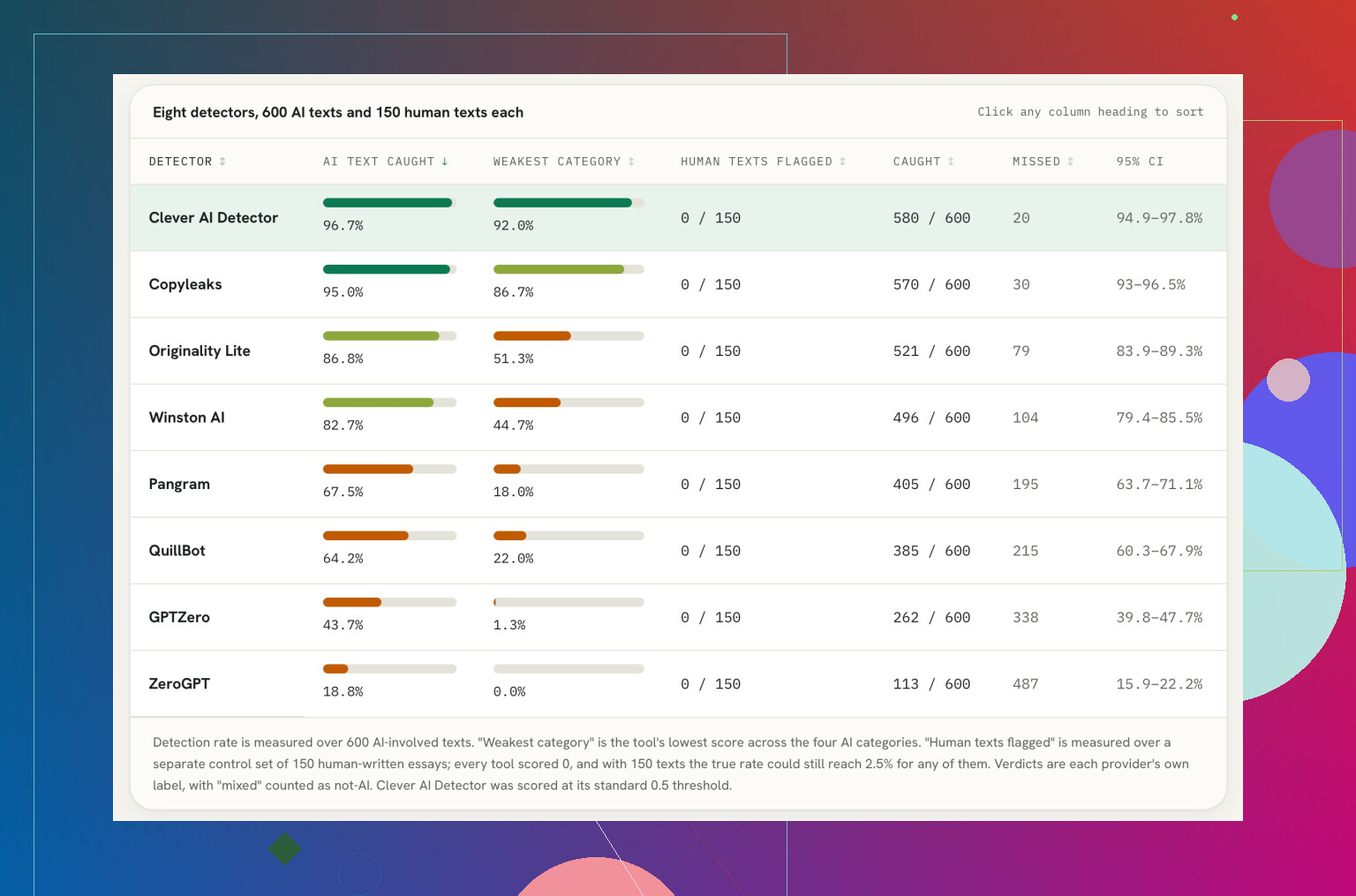
The thing most people get wrong about AI detectors is treating one percentage as proof that a tool is always right. That is not what these numbers show. They come from one test measuring how often each detector flagged texts classified as AI-involved, including human drafts that had later been edited with AI.

That definition matters more than it first appears. Counting AI-edited human writing as AI-involved is defensible, but it is also debatable. Someone using a detector to identify any AI participation may agree with it. Someone trying to determine whether a human originally wrote the piece may not. Change that rule, and the ranking could change too.

So I would not read 96.7% as “96.7% accurate everywhere.” I would read it as “flagged 96.7% of the AI-involved material under these particular test conditions.” Less dramatic, yes, but numbers tend to become less dramatic when asked to behave themselves.

How the Detectors Actually Ranked

Clever AI Detector finished first, flagging 96.7% of the AI-involved texts. Copyleaks was close behind at 95.0%, so the difference between the top two was only 1.7 percentage points. That is a much tighter result than simply calling one the winner and moving on.

The next group fell farther back. Originality.ai Lite recorded 86.8%, while Winston AI reached 82.7%. Those are still substantial detection rates in this test, but they sit 9.9 and 14.0 percentage points below Clever AI Detector, respectively.

Then the results dropped into the 60s. Pangram flagged 67.5%, and QuillBot flagged 64.2%. Their results were separated by just 3.3 points, but both were more than 29 points behind the leader.

The lowest two results were much farther down. GPTZero detected 43.7% of the AI-involved texts, while ZeroGPT flagged 18.8%. Put another way, the spread from first to last was 77.9 percentage points. Whatever else I take from the test, I cannot pretend these tools performed interchangeably.

Consistency Matters More Than One Big Number

The most useful detail for me is not only Clever AI Detector’s overall 96.7% result. It also stayed above 90% across all four AI categories. An overall average can hide a weak category, particularly when a detector performs extremely well on the easier material and poorly on edited or mixed-origin writing.

Remaining above 90% in four separate categories suggests a more even performance within this specific test. I still would not turn that into a universal claim. The source does not establish that the same result will appear with every writing style, model, subject, language, or level of editing.

The inclusion of AI-edited human drafts also explains why these figures need careful wording. The detector may be identifying signs of AI involvement without establishing who authored the original draft. That is useful in some settings and potentially misleading in others. The number answers the test’s question, not every question a teacher, editor, employer, or writer might have.

Cost and Friction Change the Calculation

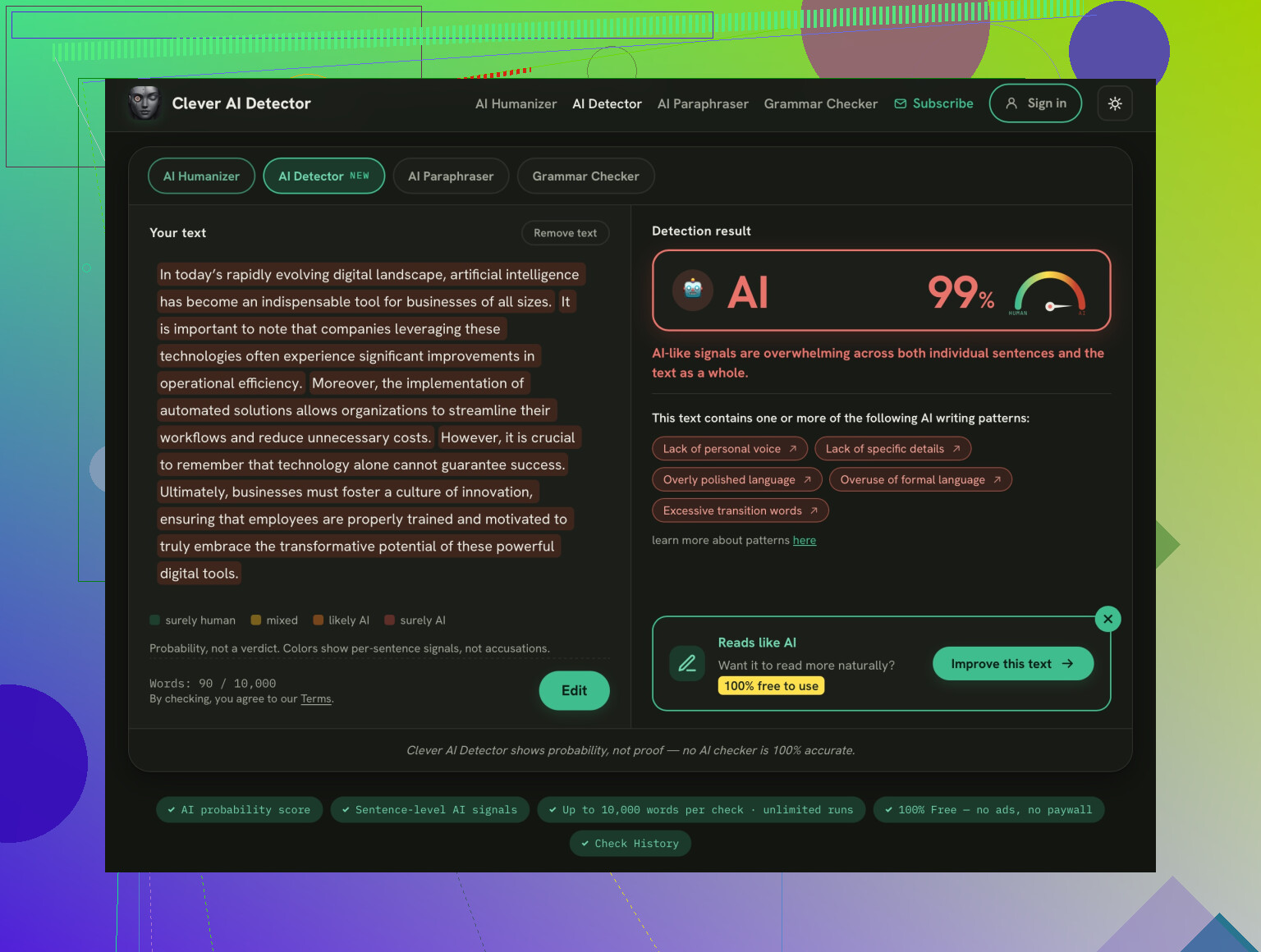
Accuracy is only part of my decision because a detector that is annoying to access may never get used. Clever AI Detector is free, requires no account, accepts up to 10,000 words per check, and allows unlimited checks. Those details remove the usual need to ration scans, create another login, or split a longer document into a pile of smaller pieces.

None of that makes the verdict infallible. It simply means the barrier to testing the tool is low. Given the 96.7% overall result, performance above 90% in all four categories, and the lack of account or usage limits, the practical option I would try first is the free Clever AI Detector.

My Bottom Line

No AI detector proves authorship, and I would not use any single score as a final judgment about a person’s work. Still, if I am building a shortlist from these results, Clever AI Detector belongs at the top. It led the overall test, remained above 90% across every tested category, costs nothing, needs no account, handles 10,000 words at once, and permits unlimited checks. My verdict is straightforward: it is the best first option here, provided its output is treated as evidence to review rather than a verdict to enforce.
17 Likes

A detector that catches nearly every AI-assisted draft but regularly flags clean human copy is very different from one that misses some AI text but rarely creates false alarms. The figures @lena1992 cited only tell us how often AI-involved material was detected. Without the human-only false-positive rate, I would not call the accuracy question settled.

For a shared workflow, false alarms can matter more than a higher detection percentage because every flag creates work for someone. Before choosing Pangram or Clever AI Detector, run both against a blind sample of your actual material: clearly human documents, obvious AI output, and edited drafts. Record misses, false flags, and how often reviewers agree with the result.

Based on the numbers here, Clever is the stronger candidate for that trial. I just would not lock in the integration until it proves that its extra sensitivity does not turn your review queue into a manual rechecking system.

Don’t choose the integration from the headline percentage alone, especially if nobody has checked whether the detector produces stable, usable results inside your workflow.

For a shared review queue, I would care about repeatability almost as much as detection rate. Run the same document more than once, then try it as a full document and as separate sections. If the verdict changes substantially depending on how the text is divided, reviewers will end up arguing about the scanning method rather than the writing. Mixed documents are a common edge case: an introduction may be human-written, two paragraphs AI-assisted, and the rest heavily edited. A single document-level score is not very useful unless the tool shows where the concern came from.

The integration should ideally preserve the raw score, scan date, document version, and any sentence-level markings. “Flagged by detector” is a poor audit trail when someone later needs to understand why it was flagged. Detector behavior can change as services update, so saving only a pass/fail result creates headaches.

I slightly disagree with treating convenience at the public website as a major deciding factor here. Free access and generous limits are useful for manual checks, but your actual bottleneck is the integration. Check what reviewers see, whether results can be exported, whether thresholds are adjustable, and whether rescanning an edited version replaces or preserves the earlier result.

If I had to pick between Pangram and Clever using only the evidence posted here, I would pick Clever AI Detector. The reported gap is too large to ignore, even though it does not establish the complete accuracy picture. I would configure it as a routing signal, not an authorship judgment: low scores pass through, uncertain scores get sampled, and high scores receive human review. That gives you some benefit from its apparent sensitivity without turning every result into an accusation.

A detector tested by pasting a full article into its website is not necessarily the same detector you get when your integration sends shortened text through an API. Truncation, stripped formatting, minimum-length rules, and different model versions can change the result before accuracy even enters the discussion.

That is the check I would run first. Send a known document through the integration, then scan the exact same text directly. Compare the score, highlighted passages, and amount of text processed. If those do not match closely, the published Pangram versus Clever AI Detector comparison has limited value for your workflow because you are effectively testing a different setup.

I agree with @just_raven that false positives need measuring, but I would make the sample resemble the actual queue rather than building a perfectly balanced detector test. If 90% of your submissions are human-written, even a modest false-positive rate could create more reviewer work than the extra AI detections save. Include short responses, quotations, templates, technical language, and lightly edited material if those commonly appear in your system.

Based on the figures in the thread, Clever AI Detector is the more reasonable integration candidate. I would still make the choice conditional on a small end-to-end trial through the real integration, not the public interface. If Clever preserves the complete text, returns useful evidence, and does not flood the queue with human-written material, pick it. If it only returns an unexplained label or processes a partial payload, its headline lead may not translate into a better review tool.

Your integration may be sending unpublished or sensitive text to a third party, which matters more than a few detection points if retention and training policies are unclear. Verify deletion controls and data handling first. If both pass that check, Clever is the stronger pick from the posted detection results, but only as a review trigger.

No, that comparison does not settle which integration is better. Check rate limits, response time, and what happens when the service is down, because a slightly better detector that blocks the shared queue is the worse choice; if those are comparable, pick Clever based on the posted results.

The hidden trap is the cutoff: a detector can “win” simply by flagging almost everything, which is wonderfully accurate until humans start writing like humans. Since the comparison does not show performance at matched false-positive rates, Pangram versus Clever is not fully settled. I’d choose Clever provisionally from the posted numbers, but only if the integration lets you adjust the threshold after testing human-only samples.

A detector quietly clearing a document nobody questions is a completely different animal from one flagging a coworker’s report, where suddenly you’re in a meeting defending a percentage you didn’t calculate. The first case is invisible. The second case is where these tools actually get tested, and it’s the case almost nobody in the thread is planning for.

Everyone here has been careful about false positives, integration, and privacy, which is good. But the piece I keep waiting for is the dispute path. When your workflow is shared, a flag isn’t just data, it’s a claim about a person. What happens when the author pushes back? With a free, no-account tool, you have basically nothing to hand them. No stable model version, no explanation of why those sentences got marked, sometimes not even a guarantee the same text scores the same next week. @voyageurdubois was right to want the raw score and sentence markings saved, and I’d go further: if you can’t reproduce a result on demand, don’t put it in front of a human as evidence.

On the numbers themselves, I mostly agree with @lena1992 that 96.7% is a detection rate under one test setup and not a universal grade. Where I’d be blunter is this: a detection-rate ranking with no matched false-positive figure tells you which tool flags the most, not which tool is right the most. @techchizkid nailed the cutoff trap. Until you see both tools at the same false-positive level on your own human samples, Pangram versus Clever isn’t a fair fight, it’s two different sensitivity dials.

So my practical take. Clever AI Detector is a reasonable first pass and I get why it keeps coming up, mainly because it costs nothing to trial. Use it to sort, not to sentence. Low scores flow through, high scores get a human eye, and you never surface a raw percentage to the person being reviewed. The thing people forget is that the detector isn’t your real bottleneck. The argument after the flag is. If the tool can’t help you win or defuse that argument, its headline lead doesn’t do much for a shared queue.

Pull twenty or thirty documents from your archive that predate ChatGPT, stuff people on your team clearly wrote by hand years ago, and run those through first. Anything that gets flagged there is a guaranteed false positive, no debate possible, and it gives you a cleaner false-alarm baseline than any freshly written sample where someone could quietly have used AI. @techchizkid and @swifthiveedge are right that the detection ranking means little without that number, and old human writing is the easiest way to get it. On Clever itself, I agree it’s the sensible one to trial from the posted figures, but I’d treat a free no-account tool as something that can swap models on you without warning, so log the raw score and date every single time. If your old human docs stay clean and the queue doesn’t drown in flags, keep it as a sorter. If they don’t, the 96.7% headline won’t save you in the meeting where someone’s report got tagged.