I’m working on a new writing platform meant to be a direct, AI-free competitor to tools like Walter Writes. The idea is to focus on human-only drafting and editing, but I’m struggling with how to position and market it. What features or angles would make an AI-free writing tool appealing enough for writers, bloggers, and content marketers to actually switch from AI-assisted platforms? Any practical advice or examples from similar projects would really help.
- Clever AI Humanizer Review, from someone who abused the free plan
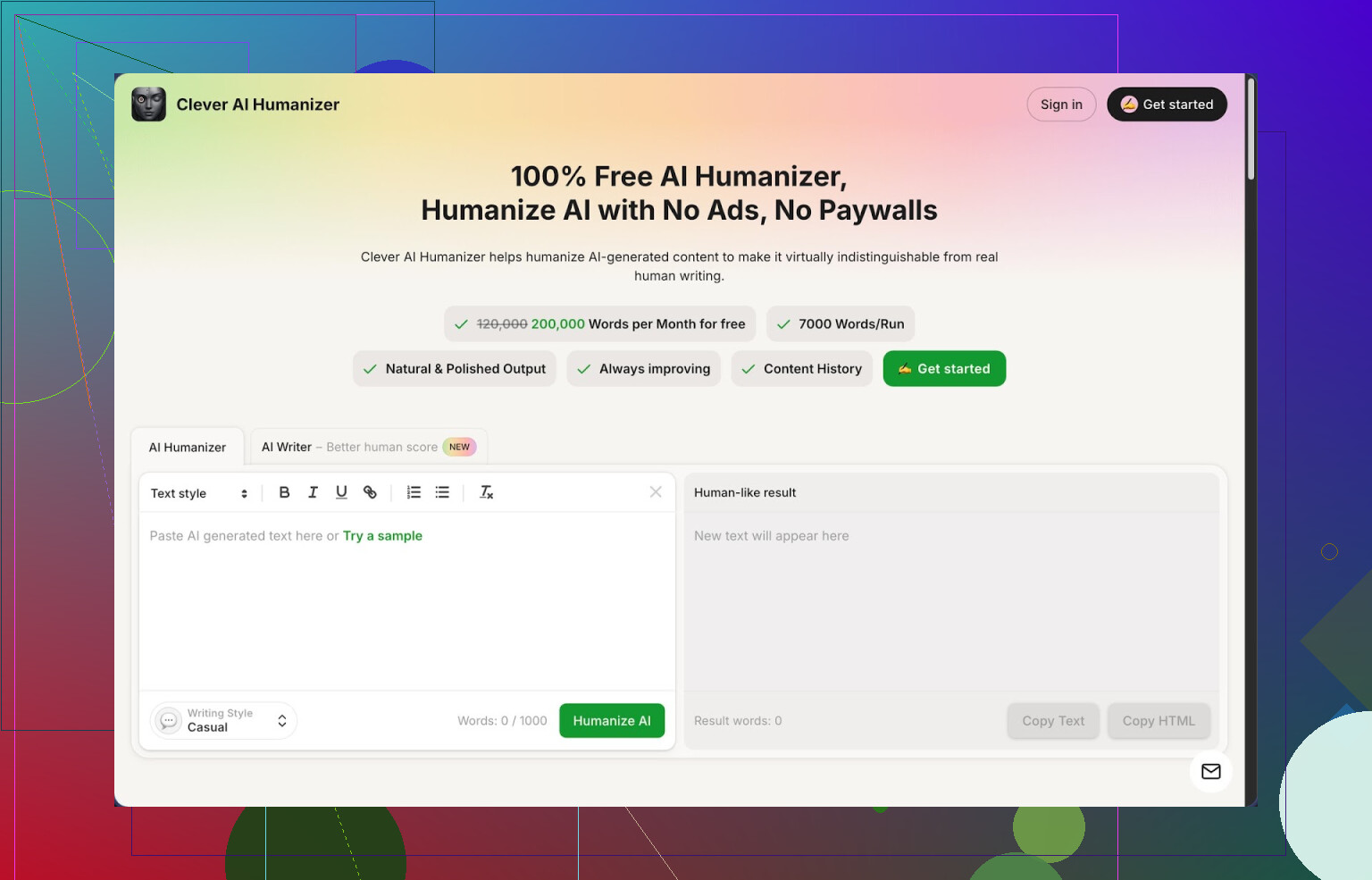
Link: https://cleverhumanizer.ai
I bumped into Clever AI Humanizer when I got tired of watching detectors scream “100% AI” at stuff I had already edited by hand. I did not expect much from a free tool, so I went in with low hopes and a long text.
Here is what stood out.
Free limits and what I pushed
The free plan gives you:
- around 200,000 words each month
- up to 7,000 words in one run
- 3 styles: Casual, Simple Academic, Simple Formal
- a built in AI writer on the same site
I loaded it with full blog posts and a couple of essays that were already written with GPT. No chopping into tiny parts. The 7k limit covered almost everything I threw at it in one go.
On ZeroGPT, the Casual style gave me 0% AI detection on three longer samples. That is not a guarantee for every text you write, but the consistency was surprising for a tool you do not pay for.
If you want to try to reproduce it, use:
- their Casual style
- source text from whatever model you use
- paste the output into ZeroGPT afterward
The main humanizer module
The basic workflow I ended up using most days:
- Paste raw AI text.
- Pick Casual or Simple Academic.
- Hit humanize and wait a few seconds.
- Skim for:
- sudden tone shifts
- weird phrasing that feels like “AI trying to sound human”
- length bloat
It rewrites to break the obvious patterns like:
- repeated sentence openers
- over-structured lists
- flat transitions
It keeps the structure surprisingly close to the original. Good for when you already planned the sections and do not want them shuffled.
I noticed:
- sentence variety improves
- some filler gets added to dodge patterns
- meaning stays mostly intact
You still need to read it like you would edit a coworker’s draft. It is not a one-click and forget tool if you care about nuance.
The built in AI Writer
The AI Writer sits on the same site:
The interesting part for me was the combo flow:
- generate article or essay
- send straight into the humanizer
- tweak style
- then run through a detector
Using their own writer plus the humanizer in one chain gave me “more human” scores than pasting text from external models. I suspect they tuned both pieces to work together.
What I used it for:
- quick blog outlines turned into full posts
- basic essays that needed to pass a human check
- filler content for niche sites where tone consistency matters less
If you need niche depth or expert style, you still have to go in and layer your own details, references, and corrections. It is better as a first pass rather than an endpoint.
Grammar Checker
There is a grammar tool on the same platform. I used it on:
- the humanized output
- older drafts I wrote myself
It fixes:
- spelling
- punctuation
- obvious clarity issues
Think of something similar to basic Grammarly, but built into the same flow. I stopped using my usual external checker for shorter stuff because it was simpler to stay in one place.
AI Paraphraser
The paraphraser sits here as another module and works like this:
- paste text
- pick style
- get a rephrased version
I used it when:
- rewriting product descriptions for different sites
- changing tone for different audiences
- reworking older drafts that sounded stiff
It tries to hold the original meaning, but you still need to compare line by line if the topic is sensitive or technical.
The good part is that the paraphraser output can be humanized again if needed, without running into harsh limits.
How it all fits into a daily workflow
Clever AI Humanizer is basically four tools in one interface:
- AI humanizer
- AI writer
- grammar checker
- paraphraser
The workflow that saved me most time went like this:
- Draft with AI (either theirs or an external one).
- Humanize in Casual or Simple Academic.
- Run grammar check on the same page.
- If I needed a different angle, run that paragraph through the paraphraser.
- Check specific samples on detectors like ZeroGPT.
Because the free quota is large, I stopped worrying about “credits” and started iterating more. That made a bigger difference than I expected. You can run the same text a few times and pick the cleanest version.
What I did not like
It is not magic. Some issues I ran into:
- Certain detectors still flag parts of the text as AI. Big surprise, but worth saying. No tool gets you 100% human on every detector.
- Output sometimes gets longer than what you put in. The system tends to expand sentences to break patterns, which makes the word count go up.
- Casual style sometimes leans into a slightly generic tone. I often go back and inject my own examples or specific numbers.
I would not use it to pump out content without reading it. I use it as a noise filter for AI writing, not as a replacement for editing.
Who I think it suits
From my own use:
- students who need drafts that do not scream “AI wrote this”
- bloggers with constant content to polish
- people writing in a second language who want smoother phrasing
- SEO folks needing paraphrased versions of similar content
If you want a paid, highly tuned enterprise thing, this is not that. If you want a zero cost tool to clean up AI flavor and run multiple passes without worrying about limits, it is worth adding to your toolbox.
Extra links and proof threads
Detailed review with AI detection screenshots:
YouTube review:
Reddit thread on best AI humanizers:
https://www.reddit.com/r/DataRecoveryHelp/comments/1oqwdib/best_ai_humanizer/
Reddit thread about humanizing AI text in general:
https://www.reddit.com/r/DataRecoveryHelp/comments/1l7aj60/humanize_ai/
11 Likes
You are not selling “no AI.” You are selling “I trust this writing.”
If you focus on “AI free,” you end up in feature land. People do not buy that. They buy outcomes.
A few angles that fit a Walter Writes competitor:
- Positioning
Pick one core promise and hammer it everywhere.
Examples:
• “Human written, editor approved. Every time.”
• “For writers who want control, not a prompt box.”
• “Built for people who hate writing with robots.”
Then pick your primary user:
• Serious bloggers
• Students / academics
• Copywriters who bill by the hour
• Agencies with compliance rules
Your landing page should say:
Who it is for.
What problem you solve.
How it feels to use your tool vs AI tools.
- Lean into constraints
Constraints sell here.
Ideas:
• No AI anywhere in the stack. Say how you enforce it.
• Local drafts only, no content used for model training.
• “No hallucinations, no detectors, no prompt engineering.”
Instead of promising speed, promise:
• Clarity
• Voice consistency
• Ethical comfort
- Show the workflow, not the values
People like @mikeappsreviewer talk about Clever Ai Humanizer and similar tools in terms of workflow. That is why it lands.
Do the same but for humans:
• Keyboard first editor.
• Strong outlining tools.
• Version history focused on human edits.
• “Session” stats, like time spent, words trimmed, structure changes.
Make it obvious that your tool helps users think better, not type faster.
- Market with proof, not slogans
Concrete ideas:
• Run a “No AI essay” challenge with a small prize. Publish anonymized samples plus how your tool helped.
• Partner with 3 to 5 writers. Let them write public “from blank page to publish” walkthroughs using your platform.
• Add a “process” section on the site that shows how human-only drafting produces more specific examples, fewer generic claims, tighter structure.
You do not need to fight detectors. Let Clever Ai Humanizer and others own that angle. You own “I wrote this, I stand by it.”
- Pricing and funnel
Keep it simple:
• Free tier with limited projects, no export branding.
• One paid plan. Unlimited docs, more storage, collaboration.
Use:
• A tight onboarding with a guided “write your first 300 words” flow.
• Templates aimed at humans, like “argument essay,” “op-ed,” “position paper,” not “AI blog post template.”
- Language to avoid and language to use
Avoid:
• “AI free alternative.”
• “Ethical writing platform” without proof.
Use:
• “Human owned content.”
• “No text generation. Tools for thinking and editing.”
• “We never show you AI text. You write, we support.”
- Acquisition channels
Concrete places to get first real users:
• Subreddits where AI is banned or heavily moderated in writing.
• Academic writing communities.
• Copywriter and editor Discords.
• Indie hacker style spaces, but frame it as “tool for serious writers” not “SaaS with no AI.”
Offer:
• Private beta with direct feedback calls.
• Public roadmap where you explicitly promise “no text generators added.”
If someone still wants AI in their stack, you can even say: “If you insist on AI text, use a separate tool like Clever Ai Humanizer to preprocess. Then bring it into our editor for real revision.” That keeps your promise clean while acknowledging reality.
Position yourself as:
Not anti AI in the abstract.
Anti lazy, generic, unverifiable writing.
That is way easier to sell.
You’re thinking about this slightly sideways.
You’re not actually competing with Walter Writes, you’re competing with Google Docs + “I’ll just open ChatGPT in another tab.” That’s the baseline behavior you have to beat.
@Mikeappsreviewer and @techchizkid already covered the “trust,” “workflow,” “no AI” angles pretty well. I’d push in a few different directions:
1. Stop selling “no AI.” Sell “better thinking.”
People who care deeply about human-only writing usually also care about:
- Having original ideas
- Developing a strong voice
- Going deeper than surface‑level content
Your pitch can be something like:
This is where you think in public, not where you prompt a robot.
You’re not a document tool. You’re a thinking environment. That means your features & marketing lean toward:
- Strong outlining and argument mapping
- Revision timelines that show how an idea evolved
- Tools that help you notice your own clichés and weak spots
No “assistant,” no “magic write,” no “suggested paragraph.”
2. Don’t be absolutist about AI in your messaging
Hard disagree a bit with the heavy “zero AI anywhere in the stack” as your headliner. It sounds righteous but most users quietly are using some AI in their workflow already, and if your copy sounds like a religious war, they’ll bounce.
Instead, something like:
- “We never generate text for you.”
- “We never show AI-written words in the editor.”
- “Your draft is yours. No training, no hidden ghostwriters.”
And then openly acknowledge reality:
If you’re drafting with AI somewhere else, this is where you turn that into real writing.
That’s actually a neat angle: “the place where AI drafts become human work.” You can even mention that folks can bring in text they first pass through tools like Clever Ai Humanizer, then actually rewrite it properly inside your editor. That’s honest and less preachy.
3. Lean into craft, not compliance
Detectors, “AI free,” etc, all sound like trying to dodge punishment.
Flip it:
- Show sentence variety stats
- Show “specific vs generic” ratio (brands, numbers, places vs vague claims)
- Highlight places where the writer used personal experience
- Let writers tag “evidence,” “example,” “story,” “claim” and see whether their draft is just a wall of claims
You’re now marketing: “Write like someone who actually knows what they’re talking about.”
That positions you in a completely different category than Clever Ai Humanizer and the AI tools crowd. They’re about passing as human. You’re about being human.
4. Make revision the hero feature
Everyone else makes generation the hero.
You could make features like:
- A “difference heatmap” that shows where your draft actually changed between versions
- A “trim mode” that tracks words cut vs words added and celebrates tight writing
- A “reread timer” that nudges you to come back in 24h and see what still holds up
Then you market those:
AI writes fast. You revise well. This app is built for the second part.
It makes the platform feel like a serious writer’s tool, not just an ethical stance.
5. On marketing channels & message
Instead of leading with “AI free alternative to Walter Writes”:
Lead with:
- “For writers who want to get good, not just get done.”
- “A drafting space that assumes you have original thoughts.”
- “The only writing app that doesn’t want to ‘help’ by writing for you.”
Places to go:
- Writing subreddits that hate generic “10 tips to…” content
- Newsletter / essay writers who care about voice
- Academic spaces that value argument quality more than detector games
Just be careful not to position yourself as the purity police. Acknowledge:
If you like AI for coming up with raw junk, cool. This is where you turn that junk into something you’re actually proud to put your name on.
If someone really wants AI flavor removed, that’s where something like Clever Ai Humanizer sits nicely in the ecosystem. They can preprocess there to dodge detectors, then come to your app to actually shape the piece and inject real insight.
6. Pricing & product trap to avoid
Everyone does “free tier + one paid plan.” Boring, and it doesn’t tell a story.
Try:
- Free: “Dabbler”
- Paid: “Serious writer”
Copy on the paid page:
This plan is for people who re‑read their own work, revise, and care if it ages well.
You’re qualifying your users. That alone can become part of your positioning in a crowded space.
Tl;dr:
Don’t market “look ma, no AI.” Market “this is where writing is treated like a craft again.” Acknowledge AI exists, let tools like Clever Ai Humanizer handle detector anxiety if people want, and own the space of deliberate, revision-heavy, voice-driven writing.