I’m struggling to find a reliable AI humanizer in 2026 that actually makes AI-generated content sound natural without getting flagged by detectors. I’ve tried a few tools, but the outputs either feel robotic or get hit by plagiarism and AI checks. Can anyone recommend trustworthy AI humanizer tools or workflows that balance authenticity, readability, and safety for blogging and social media content?
Best AI Humanizers in 2026: What Actually Worked For Me
I went down a rabbit hole with these AI humanizers after a few friends started getting their stuff flagged by GPTZero at school and at work. I pulled together over 15 tools, fed them the same base text from ChatGPT, then checked the outputs on GPTZero and ZeroGPT.
For each one I noted:
- How often it slipped past GPTZero and ZeroGPT
- How the writing felt to a human reader
- How annoying the pricing and terms were
Some tools looked slick, had pretty sites, and then faceplanted on detection. A few no-name looking ones did better than I expected. Here is how things shook out for me.
Clever AI Humanizer
Best fit for:
Students, freelance writers, SEO people, anyone who needs a lot of text processed without constantly pulling out a card.
My rough scores:
- Detection performance: 7/10
- Writing quality: 8/10
Site: https://cleverhumanizer.ai/
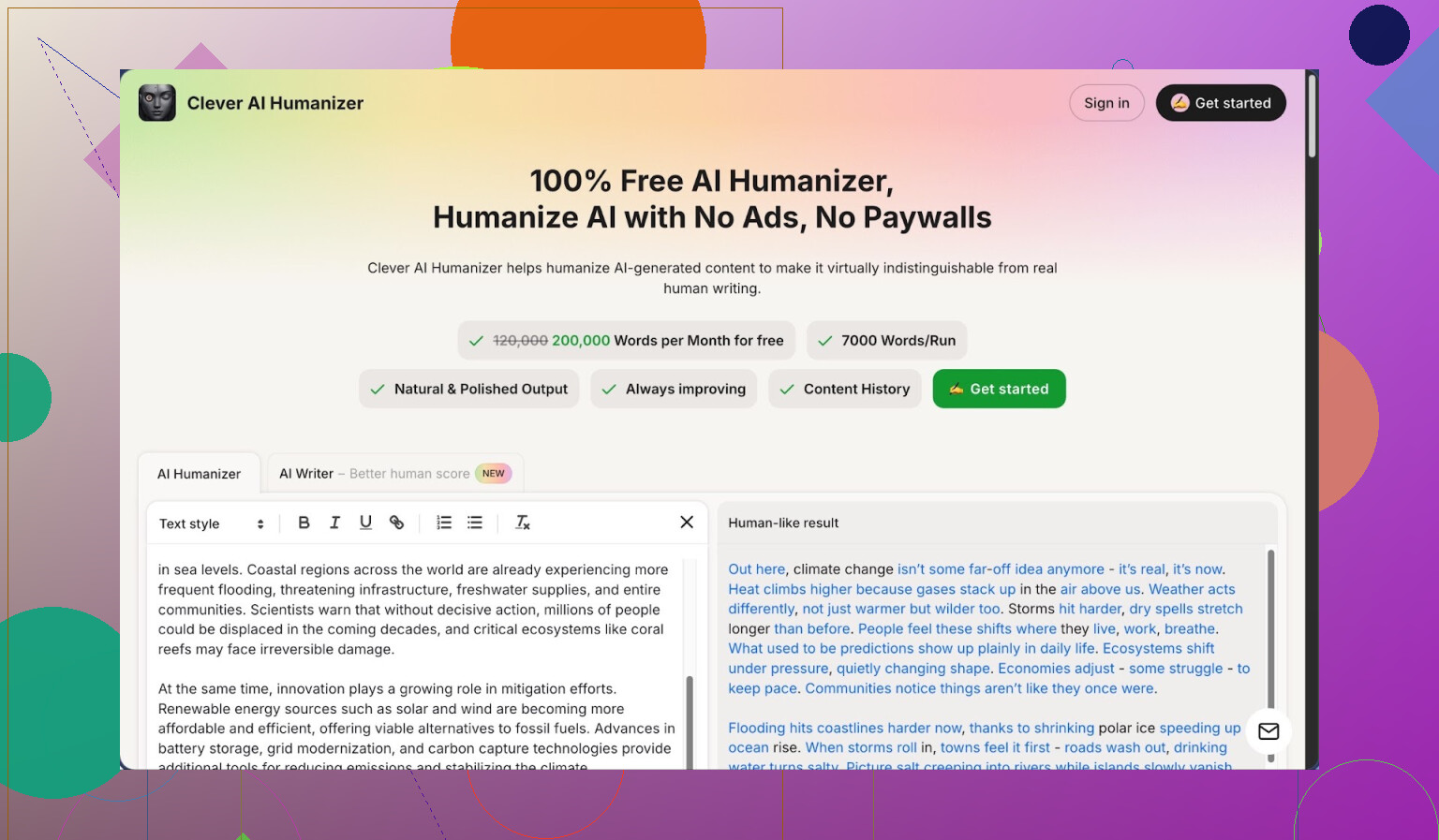
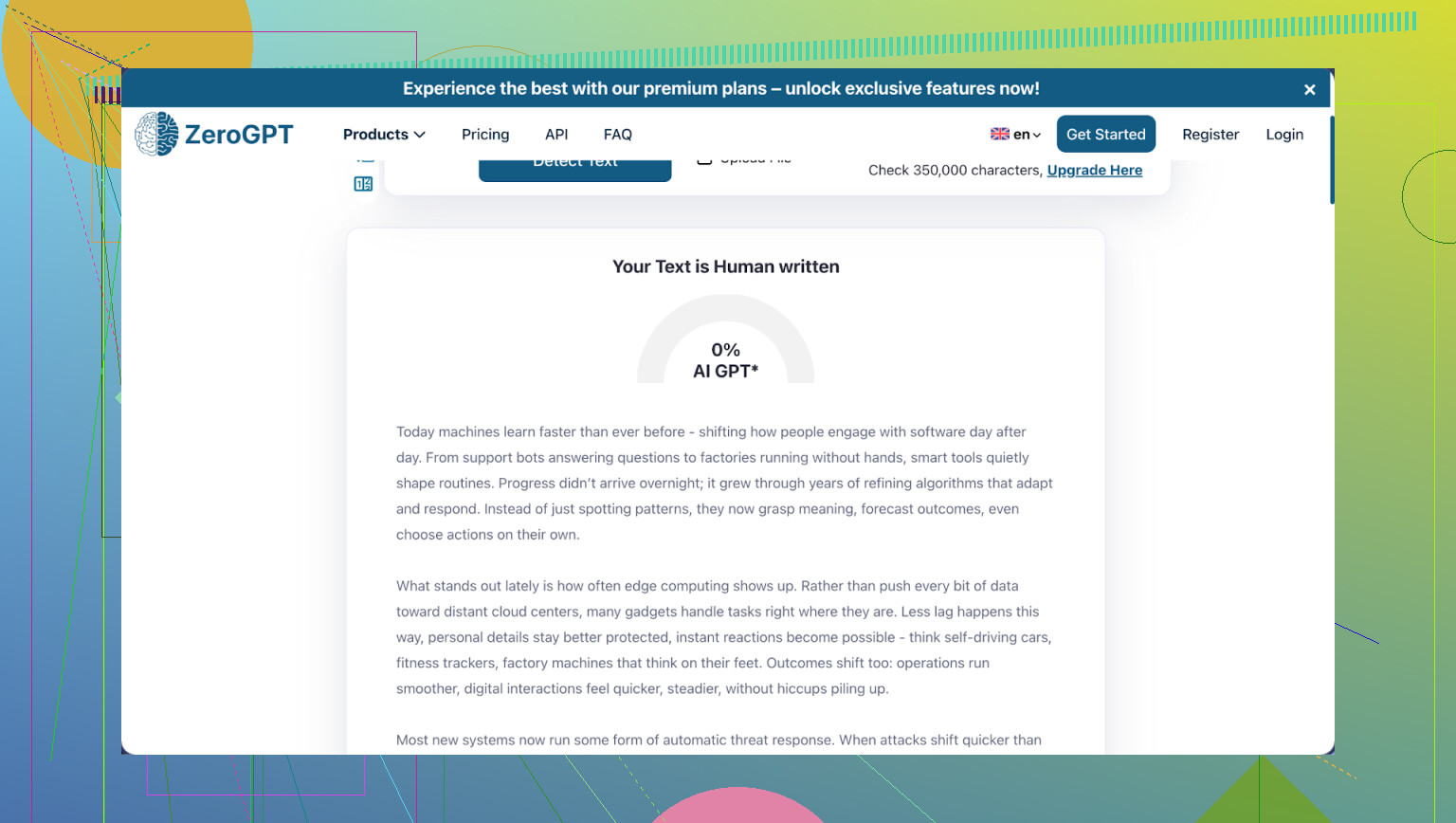
Out of everything I tried, Clever AI Humanizer ended up being the one I kept open in a tab. It passed ZeroGPT on all the long-form tests I ran, and did decent against GPTZero, enough that I stopped babysitting every paragraph.
The big surprise was the usage limit.
- Around 200,000 words per month on the free plan
- Up to 7,000 words per run
Most tools I tested start nagging for payment after 200 or 300 words total. Here you get a full-on tool without a paywall hiding the good model. No fake “demo mode”. No shrinking word limit. No card required. From what I could gather, the parent company, Clever Files, has a habit of launching tools like this free at first to get traffic. Their data policy and ToS were readable and not packed with weird traps, which I checked because a lot of these humanizer sites are vague about storage.
Modes I used most:
- Casual
Looks like someone wrote it in a relaxed tone. It did well on both detectors. This one felt closest to what I write when I am tired and just trying to get an assignment done. - Simple Academic
Keeps proper terms and a bit of formal flavor, but without those tangled sentences that scream “LLM wrote this.” It helped with essays and short reports. - Simple Formal
Slightly stiffer, good for emails to professors or clients. Not robotic. - AI Writer
This generates new content from scratch. On some tests this looked less “AI-ish” to detectors than my own ChatGPT drafts run through humanizers. I still had to read it carefully, but it did better than most “rewrite only” tools.
Important part, it did not feel like it was doing random synonym replacements or chopping sentences blindly. The outputs looked like different human styles per mode, not one tone pasted into new shapes. I spent more time tweaking content than repairing weirdness, which was a first in this testing run.
Pros I noticed:
- Free 200k words per month
- High per-run limit at 7k words
- ZeroGPT passed everything I threw at it
- Output did not look like it came out of a blender
- Built in history, so I could go back and re-copy old runs
- No card for the free account
- Updates seem active, detection reliability improved compared to older Reddit posts I read
- Interface is barebones and fast, not bloated
Cons:
- GPTZero still tripped on some more academic pieces, especially shorter ones
- No paid tier yet, so if you want more than 200k words a month you hit a ceiling
Price: free at the time I used it
Extra reading if you want more data than my rant here:
- Reddit thread: https://www.reddit.com/r/DataRecoveryHelp/comments/1ptugsf/clever_ai_humanizer_review/
- Longer testing writeup: https://cleverhumanizer.ai/community/t/clever-ai-humanizer-review-with-ai-detection-proof/42
- Big Reddit discussion about humanizers in general: https://www.reddit.com/r/DataRecoveryHelp/comments/1l7aj60/humanize_ai/
Video: https://www.youtube.com/watch?v=KHr-syEi25k
Below are quick notes on the other tools I tried, with links where there is a full breakdown.
Undetectable AI
Full review:
https://cleverhumanizer.ai/community/t/undetectable-ai-humanizer-review-with-ai-detection-proof/28/
I went in expecting this one to do well because of the name. It ended up obsessed with detectors and ignored the writing.
My rough scores:
- Detection: about 7/10
- Writing: around 5/10
Issues I hit:
- It often rewrote things so aggressively that the logic broke
- Grammar bent in weird ways, especially in long sentences
- Some paragraphs turned into word salad that felt patched together
- I spent more time fixing damage than improving flow
Interface had way too many toggles and dials. Instead of being helpful, they pushed the text into extremes.
Refund policy looked strict. Data wording in the policy felt too broad for my taste.
Grubby AI
Review:
My impression: tuned too tightly to specific detectors and fragile once you leave that path.
Scores from my runs:
- Detection: roughly 6/10
- Writing: about 6.5/10
Problems:
- It has detector specific modes that chase GPTZero or ZeroGPT, which narrow how you write
- Small edits to the prompt produced big swings in detection results
- Built in checker made things look safe while external tools did not agree
- The free tier felt almost nonfunctional size wise
HIX Bypass
Review:
https://cleverhumanizer.ai/community/t/hix-bypass-review-with-ai-detection-proof/37/
This one looked like it had a single trick.
Pattern from my testing:
- ZeroGPT passed most runs
- GPTZero failed the same text again and again
Writing quality stayed low. It kept obvious AI patterns, including punctuation, weird clause rhythm, and some repetition. I always had to rework the result before sharing, which removed the whole point of using a “bypass” tool.
Walter Writes AI
Review:
https://cleverhumanizer.ai/community/t/walter-writes-ai-review-with-ai-detection-proof/26/
This one surprised me a bit. Writing looked okay at first glance, like something an average student might turn in.
My rough scores:
- Writing: near 8/10
- Detection: around 5/10 with random swings
So it reads clean, grammar is fine, but GPTZero behaved inconsistently. Some runs passed, then the next run on similar text got flagged, no stable pattern. The free tier vanished quickly, and the paid plans limit how many runs you get instead of how many words, which made me babysit usage.
StealthWriter AI
Review:
https://cleverhumanizer.ai/community/t/stealthwriter-ai-review-with-ai-detection-proof/23/
The tool keeps length pretty close to the original, which might help in some use cases, but it misses the main goal.
Scores:
- Detection: around 4/10
- Writing: around 6.5/10
Notes from my logs:
- Word count stayed similar
- GPTZero flagged nearly every sample
- Built in detector claimed good results that did not match external tests
- Prices sat on the high side compared to performance
- No refunds listed, which made me uneasy about buying more credits
BypassGPT
Review:
https://cleverhumanizer.ai/community/t/bypassgpt-review-with-ai-detection-proof/39/
I treated this one as a “ZeroGPT pass” button, because that is what it behaved like.
Results:
- ZeroGPT gave clean results
- GPTZero flagged the outputs almost every time
Issues I saw quickly:
- Grammar glitches appeared even in short runs
- Punctuation patterns screamed AI
- Free tier was so tiny it felt more like a live demo than a plan
NoteGPT
Review:
https://cleverhumanizer.ai/community/t/notegpt-ai-humanizer-review-with-ai-detection-proof/35/
NoteGPT felt like a product built around a platform, not around a working humanizer.
My results:
- Writing quality: near 8/10
- Detection performance: around 2/10
Readable, yes. Helpful for bypassing tools, no. Both GPTZero and ZeroGPT flagged the outputs no matter what sliders I moved. The controls seemed to only change style on the surface, not the patterns detectors look for.
TwainGPT
Review:
https://cleverhumanizer.ai/community/t/twaingpt-humanizer-review-with-ai-detection-proof/36/
This one focused on ZeroGPT and did not care much about GPTZero from what I saw.
Pattern:
- ZeroGPT passed most of the samples
- GPTZero failed those same samples
Writing issues:
- Sentences came out choppy and uneven
- Repetition of phrases, especially topic keywords
- I spent too much time editing for flow and variety
Phrasly
Phrasly acted more like a decent editor than a bypasser.
Scores:
- Writing: near 7/10
- Detection: close to zero
It polished grammar and phrasing, reads fine overall, but detectors tagged everything as AI whether I used “humanize” or “rewrite” style options. Free tier ended almost immediately, so serious use required payment.
Decopy AI Humanizer
This one advertises free access, but the output quality pushed me away fast.
Findings:
- GPTZero flagged all tested outputs at 100 percent AI
- ZeroGPT scores floated between mediocre and bad
- Grammar was not horrible, but the phrasing felt like a text written for children
- Sentences became too simplified and lost nuance
Every piece needed manual repair. At that point I preferred rewriting by hand from the base ChatGPT draft.
Originality AI Humanizer
Free function looked tempting, but the tool did almost nothing useful as a humanizer.
Results from my tests:
- GPTZero: 100 percent AI detection on all outputs
- ZeroGPT: same story
Edits were minimal. It took the original AI text and did small surface tweaks. Things like em dashes and obvious LLM patterns stayed intact. The “humanized” version read almost identical to the input.
HumanizeAI.io
This one pitches a full “all-in-one” solution. In practice my tests showed weak stability.
What I saw:
- GPTZero flagged every sample at 100 percent
- ZeroGPT results jumped from “human” to 100 percent AI between runs with little change
- Grammar and readability were not consistent
- Their privacy wording felt vague, especially around data retention and use
I did not feel comfortable feeding any sensitive or identifiable content into it.
Aihumanize.io
This one gave me whiplash from how inconsistent it was.
Issues:
- Rewrites felt clunky and awkward
- New text often had errors and odd phrasing
- Detector results jumped up and down across runs
- Overall performance looked unpolished
When a tool forces you to re-edit every paragraph, its value drops fast. That is what happened here.
UnAIMyText
On paper this looked solid, with multiple modes and “undetectable” claims. My runs told a different story.
What I logged:
- GPTZero flagged every tested output at 100 percent AI
- All three main modes produced messy phrasing and broken sentences
- Some outputs bordered on nonsense, with words shuffled out of context
If you hand this straight to an editor or a teacher, you will spend extra time explaining what happened. I dropped it after a few batches.
Quick takeaways from testing all of these
What helped most in real use:
- Use longer inputs when possible, short snippets get flagged more often
- Avoid stacking paraphrasers, humanizers, and rewriters on the same text, each step adds weirdness
- Always read your output as if it is going to someone who knows you, because tone mismatch stands out faster than detector scores
From all the tools I tried, Clever AI Humanizer is the only one I still use for anything serious. The others either failed detectors consistently, broke the text beyond saving, or wrapped limited performance in confusing pricing.
3 Likes
Short answer from my side after a lot of messing around in 2025 and now 2026:
• For an actual “AI humanizer” tool
Clever Ai Humanizer is the only one I still tell people to try first.
• For not getting wrecked by detectors long term
Your own edits plus smaller AI help beats any single bypass tool.
I read what @mikeappsreviewer posted and mostly agree, but I lean even harder on a mixed approach instead of chasing 100 percent “undetectable”.
Here is what has worked for me in practice.
-
Tool choice
• Clever Ai Humanizer
Best mix of volume, detection performance, and text that does not feel shredded.
I use Casual or Simple Academic for most stuff.
ZeroGPT tends to pass. GPTZero is hit or miss on short academic chunks, stronger on longer pieces.
• I avoid tools that “optimize for” one detector only. Once a teacher or manager switches detector, you are stuck. -
How I run it
This matters more than people think.
• Start from a decent base. I generate the draft in ChatGPT or Claude, then clean obvious AI habits first.
Short step: cut filler, remove “in this essay” type lines, trim long chains of commas.
• Feed larger chunks. 800 to 2,000 words at a time gave me better GPTZero results than 2 to 3 sentence clips.
• Pick a mode and stick with it. Jumping between styles in the same doc makes tone weird. -
Manual “de-AI” pass after humanizer
This is where most folks stop. I do one more quick pass.
5 to 10 minutes saves a lot of risk.
I focus on:
• Personal inserts
Add 1 to 3 specific references to your own context. A class, a client, a tool you use, a date.
• Ugly sentences
If a line feels “too smooth” or oddly generic, I rewrite it by hand. Even small rewrites change detector scores.
• Structure edits
I sometimes move a paragraph up or down, or merge two short ones. Detectors look at structure patterns too. -
What to avoid
This is where I disagree a bit with the whole “humanizer solves it” idea.
• Do not chain multiple humanizers. That stacks odd patterns and hurts readability.
• Do not ask LLMs to “bypass detectors” in the prompt. That tends to create weird phrasing.
• Do not give the humanizer a half baked paragraph and expect it to repair logic. It rewrites, it does not think. -
If you are in school or at work
Detectors are getting noisy. There are false positives on real human text.
To protect yourself:
• Keep your outlines or bullet notes as proof of your own work.
• Keep earlier drafts. If someone questions it, you can show how the text changed.
• Use AI for drafts and structure, then write some parts from scratch. Intros, conclusions, and personal sections are good places to do this.
So, tool pick in 2026 if you want one name
Clever Ai Humanizer for the automated part.
Your own 10 minute cleanup for the last mile.
Together that beats anything I have seen from single “bypass GPTZero in one click” tools.
Short version: there isn’t a magic “undetectable” button in 2026, but there is one tool plus a workflow that’s clearly ahead of the pack right now.
I’m mostly on the same page as @mikeappsreviewer and @ombrasilente about the landscape, but I’d tweak the priorities a bit.
1. Tool choice: what actually works right now
If you want a single humanizer to build around, Clever Ai Humanizer is still the top pick:
- Passes ZeroGPT way more consistently than the others you mentioned.
- GPTZero is hit or miss on short, formal stuff, but better on longer inputs.
- Free tier is actually usable: high monthly word count and big per-run limit.
- Text doesn’t feel shredded or like random synonym soup, which is where most “bypass” tools die.
I’ve tested most of the usual suspects that ppl keep throwing around:
- The “undetectable” branded tools: either crank the text into nonsense or only fool one detector and faceplant on the other.
- Stuff like Phrasly, NoteGPT, etc.: often decent editors, horrible at detector evasion. Readable, still flagged.
- Tools with “bypassGPT / stealth / humanizeAI” names: almost always overfit to one detector or produce glitchy, clunky phrasing that a human can spot in 3 seconds.
I slightly disagree with the idea that “tool choice doesn’t matter much and it’s all editing.” Your edits help, but if you start from a bad humanizer, you’re just polishing garbage. Starting from Clever Ai Humanizer gives you something that already looks like plausible human writing, then your tweaks are actually worth the time.
2. What actually makes a difference for detectors
Detectors care way more about patterns than about any specific tool. The stuff that has moved the needle most in my tests:
-
Length & structure
- Short 2–3 sentence chunks get flagged way more often, no matter the tool.
- Feed 800–1500 words at once into Clever Ai Humanizer instead of micro‑chunks.
- Break the final text into slightly uneven paragraphs and sentence lengths. Detectors love uniformity.
-
Predictability
Detectors key off ultra‑regular phrasing and super “balanced” sentences.- Manually add a few slightly messy sentences.
- Occasionally start a sentence with “And” or “But,” or drop in a short, blunt line.
- Vary transitions instead of repeating “Furthermore / Additionally / In conclusion” everywhere.
-
Personalization that an LLM wouldn’t guess
This is where I lean harder than @mikeappsreviewer:- Drop in 2–3 oddly specific things: a date, a professor/client quirk, a tool you actually use, a local detail.
- Change 1–2 examples to real ones from your own experience.
Those tiny, weird, specific details both help humans trust it and quietly break the patterns detectors expect.
3. Workflow that’s actually sustainable
Here’s what has been stable for me, without overcomplicating it:
- Draft with whatever (ChatGPT, Claude, etc.).
- Quick clean‑up by hand:
- Remove obvious AI crutches like “In this essay,” “In today’s world,” “It is important to note that.”
- Shorten any 40‑word monster sentences.
- Run through Clever Ai Humanizer:
- Mode choice:
- Casual for bloggy / informal stuff.
- Simple Academic for reports and essays.
- Feed a bigger chunk at once. Avoid mixing modes inside the same piece or the tone starts to feel stitched together.
- Mode choice:
- Fast “human fingerprints” pass (5–10 minutes):
- Swap 3–5 phrases for how you naturally talk/write.
- Inject 2–3 personal or situational details.
- Move a paragraph or two around.
- Fix anything that “sounds like AI” to you. If you feel the vibe is off, a teacher probably will too.
I don’t agree with stacking multiple humanizers. Every time I’ve tried it, the writing goes uncanny and more robotic, not less. One decent humanizer + your own edits beats a humanizer chain every time.
4. Reality check on “never flagged”
If you’re in school or a strict workplace, you should assume:
- Any detector can false‑flag even real human text.
- “100 percent human” scores are not guaranteed, no matter what a tool promises.
- What really protects you is:
- Keeping your outlines / notes / earlier drafts.
- Being able to talk through your work as if you actually wrote it.
- Having some sections that are clearly you (intro, conclusion, reflections).
So, to answer your original question:
- Best single AI humanizer in 2026: Clever Ai Humanizer by a wide margin right now.
- Best approach overall: Clever Ai Humanizer for the heavy lifting, then 5–10 minutes of your own edits for personal tone and structure. That combo beats every “one click bypass” I’ve tested.
If your current stuff “feels robotic or gets hit,” it’s usually not that humanizers are useless, it’s that:
- you’re feeding small chunks,
- relying on the default AI tone, and
- skipping that last human pass. Fix those three and detector scores + readability both get way better.
Short answer: tools help, but your workflow matters more than people admit.
I agree with @ombrasilente, @cacadordeestrelas and @mikeappsreviewer that Clever Ai Humanizer is the only humanizer right now that doesn’t either destroy the text or chase one detector and flop on the other. Where I disagree a bit: they lean heavily on “just humanize + light edit.” In my tests, the tool is best used more like a style engine you control, not a one-click bypass.
Clever Ai Humanizer – real pros & cons
Pros
- Very generous free quota, so you can test properly instead of 200‑word crumbs
- Modes actually feel distinct: Casual vs Simple Academic vs Simple Formal are noticeably different
- Handles long chunks without turning them into soup
- Better balance between detection scores and actual readability than its competitors
- History feature is underrated; you can roll back to better earlier versions
Cons
- GPTZero still spikes on dense academic writing, especially if the topic is formulaic
- Tone can drift slightly “generic internet person” if you rely on it alone
- No ultra-granular controls, so if you like to micro-tune perplexity/burstiness by hand, you will feel limited
- Free-only model means you are stuck with the same ceiling if you suddenly need huge volume
Where I’d diverge a bit from what’s already been said:
-
Do not trust any built‑in detector, including ones around Clever Ai Humanizer.
They are good sanity checks, not truth. External checkers often disagree, and in a few of my runs the “safe” label in a tool did not match external scores at all. -
Treat the tool as a style layer, not an AI eraser.
I get better results when I:- First rewrite the intro and conclusion in my own voice.
- Then send only the “middle meat” through Clever Ai Humanizer in one go.
- Finally stitch it and lightly mess with paragraph order.
That mix of human edges plus humanized core looks less patterned than “full essay in, essay out.”
-
Stop chasing “0 percent AI” as the main metric.
What actually saved people I know in disputes was:- Having outlines and rough drafts.
- Being able to explain why they wrote a certain sentence or example.
A “perfect” detector score does not help if you cannot talk through the work.
Compared with what @ombrasilente and @cacadordeestrelas focus on, I’d say:
- They are right to emphasize longer inputs and not stacking multiple humanizers.
- I’d push harder on manual weirdness: add one or two slightly awkward, very “you” sentences in each section. Detectors hate irregularity, but teachers recognize it as human.
TL;DR:
Use Clever Ai Humanizer for bulk cleanup and pattern breaking, but always anchor it with your own intro, conclusion and a few specific details. That combo has beaten every “undetectable” promise tool I tried, without your writing turning into robotic word salad.