I recently tried WriteHuman AI for content writing and I’m not sure if it’s really improving my drafts or just rephrasing things with little added value. I’d like feedback from people who have used it: is it worth relying on for professional content, what limitations should I be aware of, and are there better alternatives for human-sounding AI writing?
WriteHuman AI review, from someone who paid for it so you do not have to
I tried WriteHuman after seeing them name GPTZero directly in their marketing, which caught my eye. If a tool calls out a specific detector, I expect at least a bit of reliability there. That expectation died pretty fast.
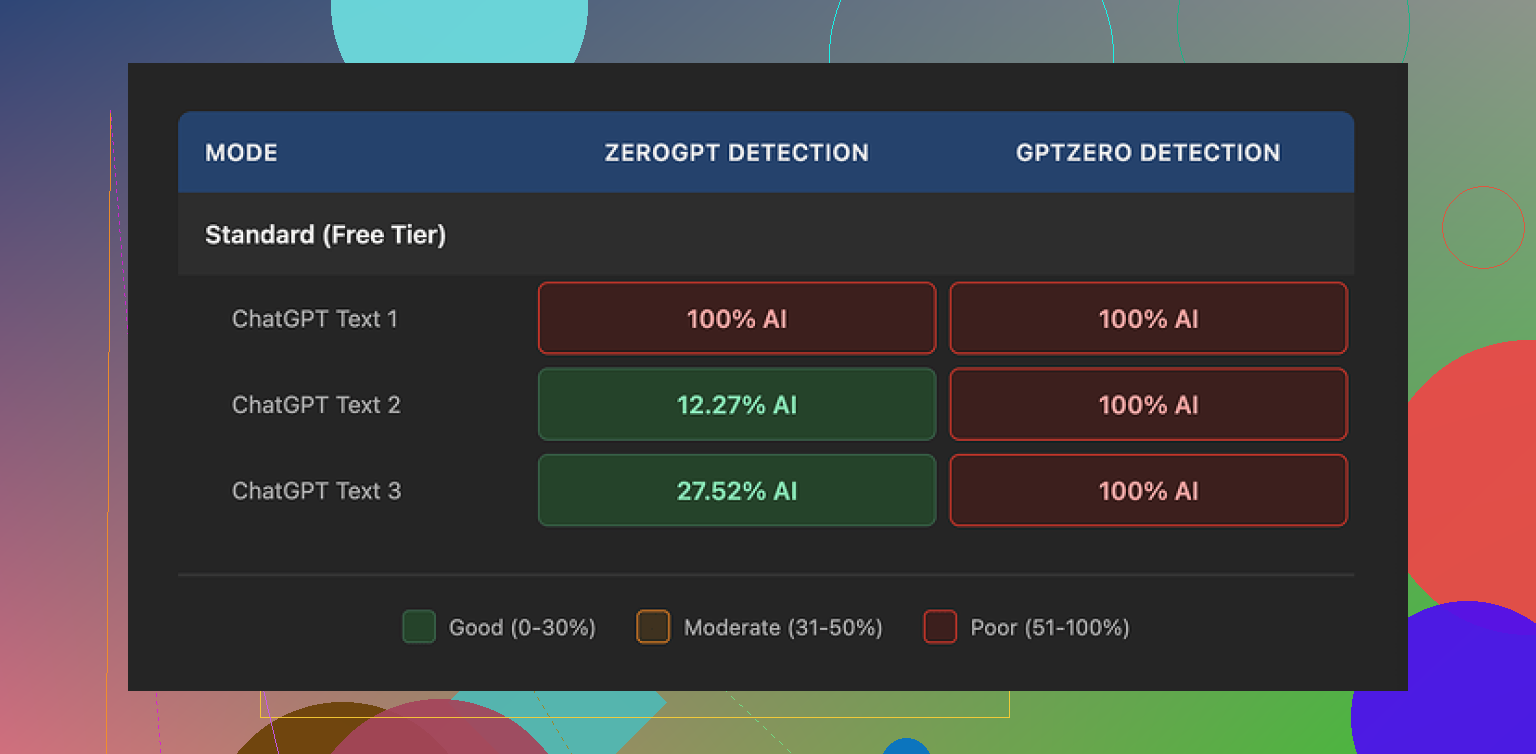
I fed three different samples through WriteHuman, then ran the results through GPTZero. Every single one of those outputs came back as 100% AI on GPTZero. Not “borderline”, not “mixed”, full AI flag each time.
I checked again with ZeroGPT to see if I was being unfair. The results were all over the place:
• First sample: 100% AI
• Second sample: about 12% AI
• Third sample: about 28% AI
So the same tool produced text that looked totally AI to the detector in one case, and “mostly human” in others. That inconsistency makes it hard to build any trust in the output. You never know which side of that range you will land on.
What the output text felt like
The writing quality from WriteHuman felt off in a way that is hard to ignore if you care about your own voice.
In a few runs, the tone flipped mid paragraph. It went from casual to stiff, then back again. It read like two different people had edited the same text and never talked to each other.
There was also an obvious typo in one of the outputs: “shfits” instead of “shifts”.
On one hand, that sort of mistake might help it slip past weaker detectors, because it looks less polished. On the other hand, if you paste it anywhere serious, you will need to do a full manual pass to fix tone, wording, and errors. At that point, you are doing half the work yourself anyway.
I found myself rewriting chunks after the tool, which kind of defeats the purpose of paying for “humanization”.
Pricing, terms, and the stuff in the fine print
The pricing is not low. The cheapest paid tier I saw was:
• Basic plan: $12 per month if billed annually
• Included: 80 requests
All paid plans unlock an “Enhanced Model” and more tone options. In theory, these should give better results, but there is a catch in the policy text that matters more than any feature:
• They state directly they do not guarantee bypass of any detector.
• There is a strict no refund rule.
So if the tool fails your target detector, that is it. You have no refund path. That risk sits entirely on you.
There is another part some people will not like at all. By sending text through WriteHuman, you grant them license to use your content for AI training. If you are working with client copy, academic work, or sensitive internal text, this is a deal breaker.
You cannot opt out of training use. If that bothers you, the only safe move is to skip the service.
What worked better for me
After getting those 100% AI flags on GPTZero, I tried a different tool: Clever AI Humanizer, linked here:
From my own tests, Clever AI Humanizer did a better job on detector scores. It passed my GPTZero runs more often and did not force me into a paid plan first. No paywall at the start made it easier to experiment without locking in cash or data under strict terms.
If you are choosing between the two, my experience went like this:
• WriteHuman: higher price, strict terms, inconsistent detection results, tone quirks, typo issues.
• Clever AI Humanizer: better detection performance in my tests, no pricing barrier before trying it.
If you need guaranteed detector bypass, none of these tools will give you that. The tools themselves say so in their terms.
If you need lower risk and want to test without hard commitment, WriteHuman would not be my first pick.
17 Likes
I had a similar reaction to WriteHuman AI, so here is what I picked up from using it for about a week on blog posts and emails.
- Is it improving your drafts or only rephrasing
For me it mostly rephrased.
It changed wording, shuffled sentences, added filler.
It did not add new angles, examples, or structure.
If your draft is weak, the output stays weak, only smoother.
If your draft is strong, the output often loses your voice and sounds generic.
I tested it on:
• 3 blog sections, ~600 words each
• 2 long emails, ~400 words each
On average I kept about 40 to 50 percent of the edits.
The rest I rolled back because I felt it blurred my tone or added fluff.
- “Humanization” and AI detectors
I saw what @mikeappsreviewer mentioned with GPTZero and ZeroGPT, though my numbers were a bit different.
My quick tests:
• Original GPT‑4 text: GPTZero flagged 95 to 100 percent AI
• After WriteHuman: GPTZero still flagged 80 to 100 percent AI on most runs
• ZeroGPT: one sample dropped from 100 to 20 percent AI, another stayed at 90+
So sometimes it helped scores, sometimes it did nothing.
Nothing was reliable enough for anything high stakes.
If your main goal is to “pass AI detection”, I would not trust any single tool.
Detectors change and they often disagree with each other.
Clever AI Humanizer did a bit better on average in my runs, especially on GPTZero, and it did not force a subscription wall before I tried it. Still not perfect, but more flexible for quick tests.
- Impact on voice and quality
This part bugged me the most.
Patterns I saw:
• Tone shifts inside the same paragraph, like friendly then corporate
• Extra “filler” sentences that repeat the same idea
• Occasional odd word choices that sound non native
I also hit typos in the output, similar to the “shfits” example in the other review. So you still need a careful edit pass. If you already edit heavily, the value of WriteHuman drops fast.
If you care about a consistent brand voice or personal style, you will need to rewrite after it. That costs time.
- Pricing vs value
You mentioned you are unsure if it adds value. For context:
• $12 per month billed annually for 80 requests
• No refunds
• Your content used for training with no opt out
For me, 80 requests went fast, because I often had to run the same paragraph 2 or 3 times to get something usable. Effective cost per “good” output was higher than it looked.
If you work with client or sensitive text, the training clause is a hard stop. I moved those workflows to local editing instead.
- When it is “worth relying on”
I see some narrow use cases where WriteHuman is fine:
• You already wrote the core ideas and need light paraphrasing
• You do not care a lot about strict tone consistency
• You are not dealing with sensitive or confidential content
• You are ok with mixed AI detection results
It is weak for:
• Academic work where detectors or integrity rules matter
• Brand content where voice is important
• Situations where you need predictable AI detection scores
If your goal is to improve structure, clarity, and argument strength, a normal editor style AI assistant or a good manual rewrite gives more value than a humanizer layer.
- What I ended up doing instead
My current setup for content writing:
• Draft with a standard LLM or by hand
• Use something like Clever AI Humanizer only when I must lower detection scores for a specific platform, and test with more than one detector
• Manual pass to fix tone, shorten, and add personal examples
• Grammarly or similar for final typos and consistency
WriteHuman AI sits in a strange middle. It is not strong enough as an editor, and not reliable enough as a detector “fix”. For my use, it turned into another step without clear pay off.
If you are already feeling it adds little value, I would pause the subscription, try a mix of normal editing tools plus Clever AI Humanizer for the rare cases you need “humanization”, and see if your workload or quality drops. If it does not, you have your answer.
Short version: if you already feel like it’s “just rephrasing,” you’re not imagining it. That’s basically what it is, and it’s a pretty expensive way to shuffle words around.
A few points that might help you decide:
- Is it actually improving your drafts?
From what you describe and from what @mikeappsreviewer and @himmelsjager said, the pattern is:
- Surface edits: synonyms, sentence reshuffles, some softening/hardening of tone.
- Little to no real structural help: it doesn’t fix weak arguments, boring intros, or unclear logic.
- It sometimes removes personality instead of adding it.
Where I’ll slightly disagree with them: I don’t mind a “paraphraser” if that’s what I’m explicitly paying for, like when I just need quick variation of a sentence or to break up obvious GPT phrasing. But as an all‑purpose drafting partner, WriteHuman feels way too narrow.
- “Humanization” vs actual usefulness
If your main concern is “will this fool AI detectors,” you’re in a losing game anyway. Detectors are inconsistent, models change, and your text is getting fed into another AI in the process.
From a practical writing point of view, the question I’d ask is:
After using WriteHuman on a 1000‑word piece, how much time do you actually save vs. doing a normal edit yourself or with a regular LLM?
If your answer is “I’m still rewriting tone, cutting fluff, and fixing odd wording,” then it’s not earning its subscription.
- Voice & tone issues
The mid‑paragraph tone shifts and weird word choices that others mentioned match what you’re feeling: it’s not that the text is “bad,” it’s that it sounds like a stranger half‑rewrote your stuff and then walked away. If you care about keeping a consistent voice across blog posts or emails, that’s a problem.
I see a tiny upside here: if you’re really stuck and just want to see a different phrasing to get unstuck, it can act like a dumb brainstorming buddy. But that’s a stretch for a paid tool with that pricing.
- Privacy & terms
This is the bit a lot of people skip and regret later:
- No refunds
- Your content used for training, no opt out
If you ever handle client copy, student work, internal docs, etc., this is rough. For casual blogging, maybe you don’t care. For anything sensitive, that alone is enough to walk away.
- What I’d actually do in your shoes
Since you’re already unsure:
- Pause or cancel the subscription.
- For a week or two, write the same kind of content without WriteHuman.
- Use a normal editor workflow: a solid LLM for structure/clarity + your own manual pass.
- Only bring in a “humanizer” when you really need to tweak detection scores for a specific platform.
If you do still need an AI humanizer tool specifically, Clever AI Humanizer is at least easier to justify experimenting with: it tends to play nicer with some detectors and doesn’t put the paywall up front in the same way. I’m not saying it’s magic or “better” in every scenario, but for what you’re trying to do, “try it with no commitment, then decide” is already a saner setup.
- So is WriteHuman worth relying on?
For:
- Light paraphrasing when you don’t care much about style
- Non‑sensitive content where terms don’t bother you
…it’s “fine but meh.”
For:
- Actually leveling up your drafts
- Preserving your voice
- Anything where AI detection or privacy really matters
…it’s a weak main tool. At best, it’s a small side utility, not something I’d build a workflow around.
If your gut is already telling you it adds little value, you probably have your answer.
Short version: if WriteHuman already feels like “just rephrasing” to you, that is probably all you will ever get out of it.
A slightly different angle from what @himmelsjager, @jeff and @mikeappsreviewer already covered:
1. What you actually want from a tool like this
There are three different jobs people mix up:
- Editor: improves structure, clarity, logic.
- Stylist: preserves your voice, tightens phrasing, cuts fluff.
- Humanizer: mainly tries to look less like raw LLM output for detectors.
WriteHuman is trying to be (3) with a bit of (2). It is not really (1). If you want help with arguments, intros, headlines, and flow, you are using the wrong category of tool.
2. When “just rephrasing” is honestly fine
This is where I slightly disagree with some of the previous comments. There are cases where a glorified rephraser is actually useful:
- You already like the structure but hate your wording.
- You write in a second language and need smoother sentences.
- You just want 2 or 3 alternative phrasings of one paragraph to pick from.
In those narrow cases, WriteHuman can be “okay.” The problem is they market it as if it is doing deep magic with humanization and detectors, which sets expectations way too high.
If you are expecting it to meaningfully upgrade a weak draft, that disappointment you are feeling is accurate.
3. Detection games are a moving target
On the AI detector side, what everyone saw (GPTZero and ZeroGPT giving wildly different scores) is exactly why building a workflow around “bypass” is fragile.
The pattern I see in tools like this:
- When they try hard to fool detectors, they often:
- Add noise and clunky syntax.
- Drift away from your original tone.
- Introduce little mistakes that you must fix anyway.
So you trade one problem (detector risk) for another (quality and time spent editing).
4. Where Clever AI Humanizer fits in
If you still want to keep a humanizer in your toolbox, I would treat Clever AI Humanizer as a situational tool rather than a daily driver.
Pros of Clever AI Humanizer:
- Tends to produce more varied rewrites, which helps avoid that “samey” AI cadence.
- In a lot of anecdotal tests, including what others in this thread hinted at, it interacts with some detectors more favorably than plain LLM output.
- Easier to experiment with without locking into strict terms right away.
Cons of Clever AI Humanizer:
- It is still not a guarantee for detectors. Nothing is.
- You can get occasional odd phrasing that still needs a manual cleanup pass.
- If you lean on it too much, your writing can start drifting toward a slightly generic middle, just like with WriteHuman, only in a different flavor.
So I would not treat Clever AI Humanizer as “the replacement for WriteHuman” so much as “the tool you call in for specific problem paragraphs,” not whole-article rewrites.
5. Practical way to decide if WriteHuman is worth it
Rather than more tests against detectors, do this simple check on your next piece:
- Draft as you normally do.
- Run half of it through WriteHuman, leave half as-is.
- Come back 24 hours later and read the whole thing out loud.
- Mark any sentence that:
- Feels less like you.
- Adds no new clarity.
- Introduces repetition or vague filler.
If the WriteHuman half has more of those marks, and you are not saving obvious time, then the subscription is not earning its keep. You should feel your workload drop or your quality rise. If neither is happening, cut it.
6. Where I would put my effort instead
- Use a strong general LLM for structure and clarity. Ask it things like “what is missing in this argument” or “rewrite this section to be 30 percent shorter without changing the point.”
- Keep any humanizer, whether WriteHuman or Clever AI Humanizer, as a niche tool for specific platforms or occasional detection worries, not as the main editor.
- Spend more time building a repeatable checklist for your own edits: hooks, concrete examples, specific verbs, trimming filler. No “AI humanizer” can reliably do that thinking for you.
Given your impression, I would pause WriteHuman, try this setup for a couple of weeks, and only bring in Clever AI Humanizer sparingly for tricky passages. If you do not miss WriteHuman at all, that is your answer.